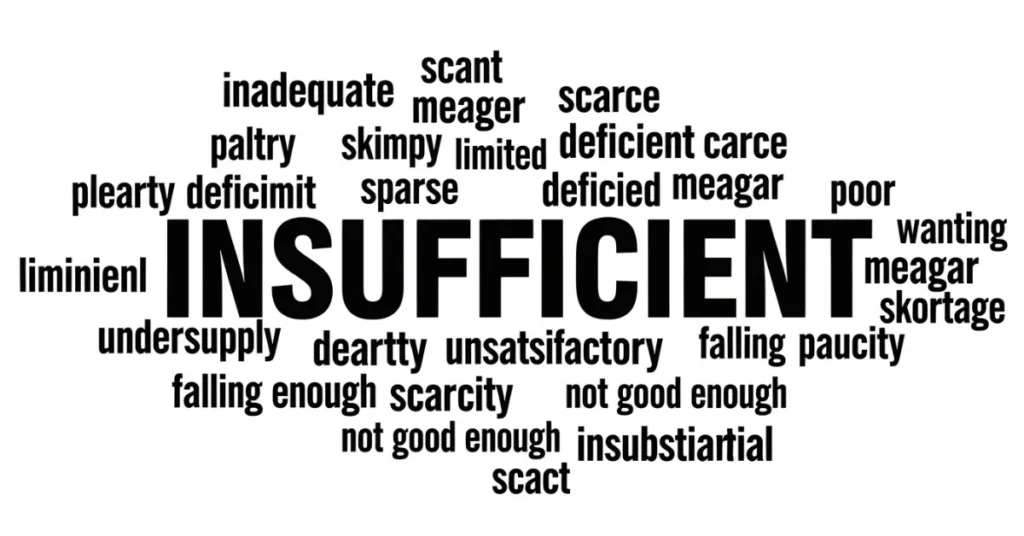
Sometimes we need something, but there is not enough. Maybe it’s money, food, or time. When there isn’t enough of what is needed, we call it insufficient.
Insufficient means not enough or lacking what is needed. Learning synonyms of insufficient helps speakers describe shortage, lack, or inadequacy clearly. These words are useful in stories, essays, blogs, and daily conversations.
Synonyms List
1. Inadequate
Meaning: Not enough or not good enough.
Difference: Inadequate focuses on quality or amount being too low.
Examples:
- The food was inadequate for the guests.
- His explanation was inadequate for the question.
2. Deficient
Meaning: Lacking something necessary.
Difference: Deficient is formal and often used for skills or resources.
Examples:
- She was deficient in vitamins.
- The report was deficient in details.
3. Scarce
Meaning: Hard to find or not enough.
Difference: Scarce emphasizes rarity as well as insufficiency.
Examples:
- Water was scarce during the drought.
- Good seats were scarce at the theater.
4. Limited
Meaning: Small in amount or extent.
Difference: Limited can describe capacity or quantity restrictions.
Examples:
- We have limited time to finish.
- The offer is limited to five people.
5. Short
Meaning: Not enough.
Difference: Short is simple and common in daily speech.
Examples:
- We are short of chairs.
- He was short on money.
6. Meager
Meaning: Very small or not enough.
Difference: Meager often implies disappointment at the small amount.
Examples:
- He got a meager salary.
- The meal was meager and unfulfilling.
7. Insufficient
Meaning: Not enough or lacking.
Difference: Insufficient is the standard word for formal and everyday use.
Examples:
- The evidence was insufficient to prove the case.
- Our supplies were insufficient for everyone.
8. Sparse
Meaning: Thinly spread or not enough.
Difference: Sparse focuses on space or distribution, not just quantity.
Examples:
- The vegetation was sparse in the desert.
- Attendance was sparse at the meeting.
9. Incomplete
Meaning: Not finished or missing parts.
Difference: Incomplete emphasizes something unfinished rather than small in amount.
Examples:
- The assignment was incomplete.
- His explanation was incomplete.
10. Under
Meaning: Below what is needed.
Difference: Under is simple and often paired with numbers or levels.
Examples:
- We are under budget.
- She scored under the passing mark.
11. Defective
Meaning: Having problems or not working right.
Difference: Defective emphasizes flaw or malfunction as insufficiency.
Examples:
- The product was defective.
- The machine was defective and unusable.
12. Inadequate in number
Meaning: Not enough in quantity.
Difference: Emphasizes count or amount being low.
Examples:
- There were inadequate numbers of volunteers.
- The chairs were inadequate in number.
13. Poor
Meaning: Low quality or not enough.
Difference: Poor can describe quality or quantity.
Examples:
- The meal was poor.
- The evidence was poor.
14. Wanting
Meaning: Lacking or missing.
Difference: Wanting is formal and often literary.
Examples:
- His work was wanting in effort.
- The plan was detailed.
15. Lacking
Meaning: Not having enough.
Difference: Lacking is common in daily use.
Examples:
- He is lacking confidence.
- The food is lacking in quantity.
16. Incomplete
Meaning: Not finished or enough.
Difference: Focuses on missing parts, not just amount.
Examples:
- The report was incomplete.
- The puzzle is incomplete.
17. Substandard
Meaning: Below the required level.
Difference: Substandard emphasizes poor quality.
Examples:
- The materials were substandard.
- His work was substandard.
18. Minimal
Meaning: The smallest possible amount.
Difference: Minimal emphasizes the bare minimum.
Examples:
- They had minimal resources.
- Her participation was minimal.
19. Scant
Meaning: Barely enough or little.
Difference: Scant emphasizes small quantities.
Examples:
- We have a scant supply of water.
- His explanation was scant.
20. Exiguous
Meaning: Very small or insufficient.
Difference: Exiguous is formal and rare; emphasizes extreme insufficiency.
Examples:
- The budget was exiguous.
- There was exiguous evidence.
21. Measly
Meaning: Very small or not enough.
Difference: Measly is informal and often negative.
Examples:
- He received a measly reward.
- The meal was measly.
22. Insignificant
Meaning: Not enough to matter.
Difference: Insignificant emphasizes lack of importance rather than quantity.
Examples:
- His contribution was insignificant.
- The difference is insignificant.
23. Insubstantial
Meaning: Weak or not enough.
Difference: Insubstantial emphasizes weakness or fragility.
Examples:
- The evidence was insubstantial.
- The shelter was insubstantial.
24. Unacceptable
Meaning: Not enough to meet standards.
Difference: Unacceptable emphasizes failing standards.
Examples:
- The food was unacceptable.
- His excuses were unacceptable.
25. Deficient in quality
Meaning: Not good enough.
Difference: Emphasizes poor quality rather than amount.
Examples:
- The work was deficient in quality.
- Their materials were deficient in quality.
26. Minimalist
Meaning: Very small or bare.
Difference: Minimalist emphasizes simplicity and low quantity.
Examples:
- His effort was minimalist.
- The design was minimalist.
27. Short-handed
Meaning: Not enough people to do the work.
Difference: Emphasizes shortage of people.
Examples:
- The team was short-handed.
- We are short-handed today.
28. Defective in supply
Meaning: Lacking proper amount.
Difference: Emphasizes shortage in supply.
Examples:
- The warehouse is defective in supply.
- Their stock was defective in supply.
29. Measurable lack
Meaning: Noticeable shortage.
Difference: Emphasizes quantifiable insufficiency.
Examples:
- There was a measurable lack of evidence.
- The project showed measurable lack of support.
30. In short supply
Meaning: Not enough available.
Difference: Common phrase for low quantity.
Examples:
- Masks were in short supply.
- Water was in short supply.
31. Thin
Meaning: Not enough or very small.
Difference: Thin emphasizes quantity or amount visually.
Examples:
- The soup was thin.
- The crowd was thin.
32. Poorly supplied
Meaning: Not enough provided.
Difference: Focuses on provision or resources.
Examples:
- The office was poorly supplied.
- The soldiers were poorly supplied.
33. Incomplete provision
Meaning: Not enough given or prepared.
Difference: Focuses on what is provided, not needed.
Examples:
- The school had incomplete provision of books.
- The kits were incomplete.
34. Limited quantity
Meaning: Small amount.
Difference: Emphasizes number or amount limitation.
Examples:
- There was a limited quantity of snacks.
- The tickets are limited.
35. Scarcity
Meaning: Not enough of something.
Difference: Scarcity emphasizes rarity and insufficiency.
Examples:
- There is scarcity of food in the village.
- Water scarcity is a big problem.
36. Shortage
Meaning: Not enough available.
Difference: Shortage emphasizes practical insufficiency.
Examples:
- There is a shortage of teachers.
- We face a shortage of fuel.
37. Insufficiently
Meaning: Not enough.
Difference: Adverb form of insufficient, emphasizes action or state.
Examples:
- The team was insufficiently trained.
- The funds were insufficiently allocated.
38. Bare
Meaning: Minimal or not enough.
Difference: Bare emphasizes emptiness or lack.
Examples:
- The room was bare.
- He had bare essentials.
39. Wanting
Meaning: Lacking or not enough.
Difference: Wanting is literary/formal; emphasizes insufficiency.
Examples:
- His knowledge was wanting.
- The meal was delicious.
40. Paltry
Meaning: Very small and not enough.
Difference: Paltry emphasizes a weak or meager amount.
Examples:
- He earned a paltry sum.
- The food portion was paltry.
41. Minor
Meaning: Small and insufficient.
Difference: Minor emphasizes low importance or size.
Examples:
- The injury was minor.
- The effect was minor.
42. Insufficient amount
Meaning: Not enough quantity.
Difference: Straightforward synonym; emphasizes exact shortfall.
Examples:
- We have an insufficient amount of paper.
- There is an insufficient amount of sugar.
43. Weak
Meaning: Not enough in strength or effect.
Difference: Weak emphasizes lack of power.
Examples:
- The medicine was weak.
- The signal was weak.
44. Sparse in supply
Meaning: Very little available.
Difference: Focuses on distribution and availability.
Examples:
- The town was sparse in supply of goods.
- Water was sparse in supply.
45. Limited resources
Meaning: Not enough resources.
Difference: Emphasizes resource restriction.
Examples:
- The school had limited resources.
- The country has limited resources.
46. Restricted
Meaning: Limited or not enough.
Difference: Restricted emphasizes rules or limits.
Examples:
- Access is restricted.
- Food is restricted in portions.
47. Few
Meaning: Very small number.
Difference: Few emphasizes quantity, not quality.
Examples:
- Few people attended.
- Few supplies remained.
48. Not enough
Meaning: Simple and direct.
Difference: Most common, everyday way to say insufficient.
Examples:
- There is not enough water.
- The food is not enough for everyone.
49. Undersized
Meaning: Smaller than needed.
Difference: Focuses on physical size being insufficient.
Examples:
- The shirt was undersized.
- The room was undersized for the party.
50. Inadequate supply
Meaning: Not enough of what is needed.
Difference: Emphasizes supply rather than quality.
Examples:
- There was an inadequate supply of chairs.
- The hospital had an inadequate supply of medicine.
Conclusion
Learning synonyms of insufficient helps you describe shortages, lack, or small amounts clearly. These words improve your writing, speaking, and storytelling. Using varied words makes your communication stronger and more precise.

I am a passionate English content writer and vocabulary specialist dedicated to creating clear, engaging, and easy-to-understand articles. I focus on helping readers expand their vocabulary and improve their English skills through simple, informative, and practical content. My goal is to make learning English enjoyable, accessible, and meaningful for everyone.