One day, Juan raised his hand in class. He wanted to know the answer, so he asked a question. His teacher smiled and answered carefully.
A question is when you want to know something. It can be spoken, written, or even in your mind. Students ask questions in school. Bloggers ask questions to readers. Writers use questions to make stories more interesting.
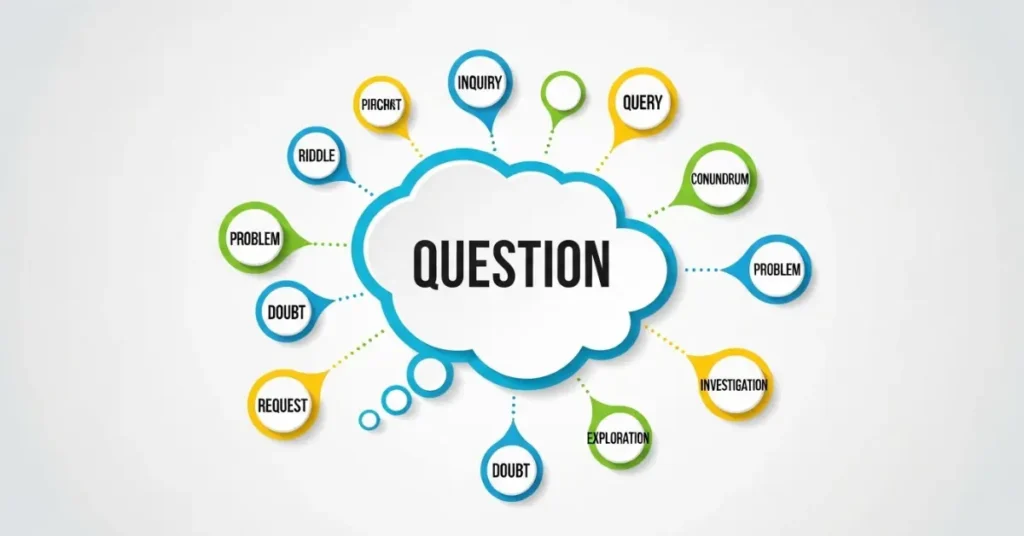
Let’s explore 50 simple words you can use instead of “question.”
Synonyms List
Ask
Meaning: To request information.
Examples:
- She asked her teacher about homework.
- He asked the way to school.
Inquiry
Meaning: A formal question or request for information.
Examples:
- The police made an inquiry.
- She sent an inquiry about the job.
Query
Meaning: A question.
Examples:
- He had a query about the book.
- The student sent a query to the teacher.
Problem
Meaning: Something you ask about to find a solution.
Examples:
- The math problem was hard.
- He solved the problem quickly.
Investigation
Meaning: Asking questions to find answers.
Examples:
- The police did an investigation.
- She did an investigation for her project.
Doubt
Meaning: Feeling unsure and asking about it.
Examples:
- I have a doubt about this lesson.
- He had doubts about the answer.
Examination
Meaning: Asking questions to check understanding.
Examples:
- The teacher gave an examination.
- She passed the examination.
Test
Meaning: A way to ask questions and check knowledge.
Examples:
- We took a science test.
- The test had many questions.
Interrogation
Meaning: Asking many questions, often formally.
Examples:
- The detective did an interrogation.
- The teacher’s interrogation was strict.
Quiz
Meaning: A short set of questions.
Examples:
- We had a quiz in class.
- The quiz was fun.
Challenge
Meaning: A question that tests skill.
Examples:
- The riddle was a challenge.
- He accepted the challenge.
Request
Meaning: Asking for something politely.
Examples:
- She made a request for help.
- He requested more time.
Prompt
Meaning: Something that makes you ask or answer.
Examples:
- The story prompt made him ask questions.
- She followed the prompt carefully.
Petition
Meaning: A formal request or question.
Examples:
- They sent a petition to the mayor.
- The petition asked for more books.
Inquiry Form
Meaning: Paper or online form to ask questions.
Examples:
- Fill out the inquiry form.
- The inquiry form was easy to use.
Probe
Meaning: Asking deeply to find answers.
Examples:
- The journalist probed for answers.
- The doctor probed carefully.
Interpellation
Meaning: Formal question, often in politics.
Examples:
- The senator made an interpellation.
- Interpellation helps check rules.
Catechism
Meaning: A set of questions for learning.
Examples:
- They used a catechism to study religion.
- Catechism teaches through questions.
Curiosity
Meaning: Wanting to know something.
Examples:
- Her curiosity made her ask many questions.
- Curiosity helps learning.
Investigation Form
Meaning: Paper to ask for details.
Examples:
- Complete the investigation form.
- The investigation form asked many questions.
Examination Paper
Meaning: Paper with questions.
Examples:
- The examination paper was long.
- He finished the examination paper.
Inquiry Letter
Meaning: Letter asking questions.
Examples:
- She wrote an inquiry letter to the school.
- Inquiry letters need clear questions.
Cross-Examination
Meaning: Asking questions to check truth.
Examples:
- The lawyer did a cross-examination.
- Cross-examination is used in court.
Doubt Clearing
Meaning: Asking to remove doubts.
Examples:
- He asked for doubt clearing.
- Doubt clearing helped her understand.
Questioning
Meaning: The act of asking questions.
Examples:
- Questioning is important in class.
- The teacher’s questioning was fair.
Issue
Meaning: Something to ask about.
Examples:
- There was an issue with the homework.
- They asked questions about the issue.
Matter
Meaning: A topic for questions.
Examples:
- The matter is serious.
- She asked questions about the matter.
Subject
Meaning: Topic of a question.
Examples:
- The subject is history.
- He asked questions on the subject.
Topic
Meaning: What the question is about.
Examples:
- The topic of the test was plants.
- She asked about the topic.
Problematic Question
Meaning: A question that is tricky.
Examples:
- The math question was problematic.
- He solved the problematic question.
Riddle
Meaning: A question that is tricky or fun.
Examples:
- The riddle was hard.
- He solved the riddle.
Conundrum
Meaning: A confusing question or problem.
Examples:
- The conundrum was solved slowly.
- He liked solving conundrums.
Brain Teaser
Meaning: A question that makes you think.
Examples:
- The brain teaser was fun.
- She solved the brain teaser.
Puzzle
Meaning: Question to find an answer.
Examples:
- The puzzle had many questions.
- He solved the puzzle.
Inquiry Session
Meaning: Time to ask questions.
Examples:
- The teacher held an inquiry session.
- She asked many questions in the session.
Interrogatory
Meaning: Formal set of questions.
Examples:
- The police sent an interrogatory.
- He answered the interrogatory carefully.
Interrogative
Meaning: Form of a question.
Examples:
- “Why?” is an interrogative word.
- She used interrogative sentences.
Examination Question
Meaning: Question in a test.
Examples:
- The examination question was easy.
- He read each examination question.
Query Form
Meaning: Paper or form to ask questions.
Examples:
- Fill the query form.
- The query form asked simple questions.
Challenge Question
Meaning: Question that tests skill.
Examples:
- The challenge question was hard.
- He solved the challenge question.
Inquiry Task
Meaning: Task to ask and find answers.
Examples:
- The inquiry task was assigned.
- She completed the inquiry task.
Cross-Check
Meaning: Asking questions to verify.
Examples:
- Cross-check the answers.
- The teacher cross-checked our questions.
Verification
Meaning: Asking questions to confirm.
Examples:
- Verification of facts is important.
- He verified the answers.
Conclusion
Learning synonyms of question helps you speak, write, and think better. You can ask, investigate, solve problems, or explore topics in many ways. Practice these words in class, at home, or in stories to become a stronger communicator.

I am a passionate English content writer and vocabulary specialist dedicated to creating clear, engaging, and easy-to-understand articles. I focus on helping readers expand their vocabulary and improve their English skills through simple, informative, and practical content. My goal is to make learning English enjoyable, accessible, and meaningful for everyone.