In a classroom debate, one student said, “School uniforms should be compulsory.” Another student replied, “But uniforms limit personal expression.” The teacher said, “That second idea is a counterclaim.”
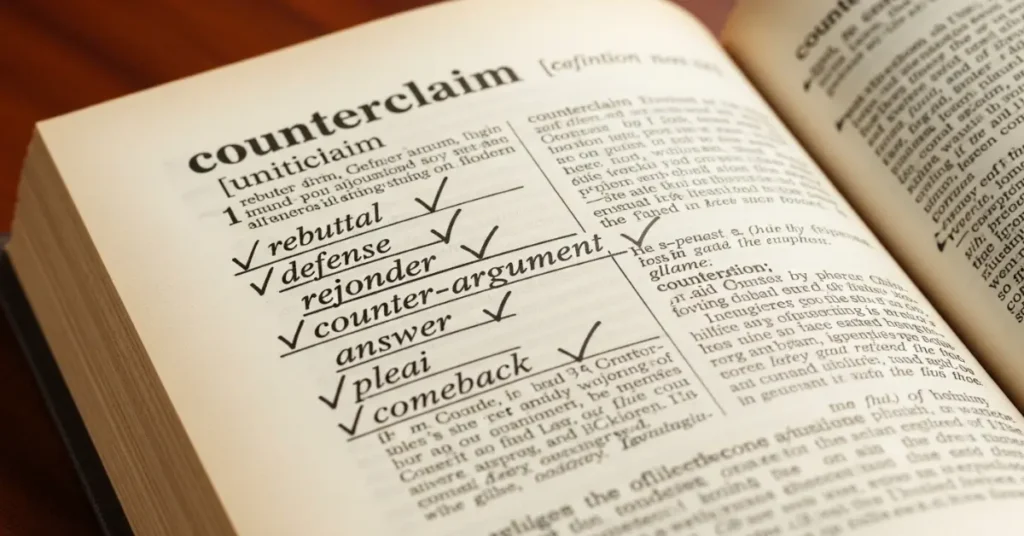
The word counterclaim means a different idea given in response to another claim. It is widely used in debates, essays, and discussions. Learning synonyms for counterclaim helps students express disagreement clearly in simple English.
synonyms list
1. Opposing claim
Meaning: A claim that disagrees with another idea.
Examples:
- He gave an opposing claim in the debate.
- The student made an opposing claim.
2. Counter argument
Meaning: An argument that goes against another argument.
Examples:
- She gave a counter argument.
- The essay included a counter argument.
3. Opposite claim
Meaning: A claim that is completely against another idea.
Examples:
- He made an opposite claim.
- The opposite claim was explained clearly.
4. Rebuttal claim
Meaning: A claim used to reject another statement.
Examples:
- She gave a rebuttal claim.
- The rebuttal claim changed the debate.
5. Refuting claim
Meaning: A claim that proves another idea wrong.
Examples:
- He made a refuting claim.
- The refuting claim was strong.
6. Contradicting claim
Meaning: A claim that directly disagrees.
Examples:
- She gave a contradicting claim.
- The contradicting claim confused others.
7. Alternative claim
Meaning: A different idea presented instead of the main one.
Examples:
- He gave an alternative claim.
- The alternative claim was useful.
8. Disagreeing statement
Meaning: A statement that shows disagreement.
Examples:
- She made a disagreeing statement.
- The disagreeing statement was clear.
9. Opposing statement
Meaning: A statement against another idea.
Examples:
- He gave an opposing statement.
- The opposing statement was logical.
10. Counter statement
Meaning: A statement that responds with opposition.
Examples:
- She gave a counter statement.
- The counter statement was strong.
11. Rebuttal
Meaning: A reply that disagrees with a claim.
Examples:
- He gave a rebuttal.
- The rebuttal changed opinions.
12. Opposition point
Meaning: A point that disagrees with another idea.
Examples:
- She raised an opposition point.
- The opposition point was valid.
13. Contradiction
Meaning: A statement that opposes another idea.
Examples:
- His answer was a contradiction.
- The contradiction was clear.
14. Reverse claim
Meaning: A claim that is the opposite of another.
Examples:
- He made a reverse claim.
- The reverse claim was explained well.
15. Disputing claim
Meaning: A claim that argues against something.
Examples:
- She gave a disputing claim.
- The disputing claim was strong.
16. Challenging claim
Meaning: A claim that questions another idea.
Examples:
- He made a challenging claim.
- The challenging claim started debate.
17. Denying claim
Meaning: A claim that refuses another idea.
Examples:
- She denied the claim.
- The denying claim was clear.
18. Refusal claim
Meaning: A claim that rejects agreement.
Examples:
- He made a refusal claim.
- The refusal claim was strong.
19. Argument against
Meaning: A reason that disagrees with something.
Examples:
- She gave an argument against it.
- The argument against it was logical.
20. Opposition argument
Meaning: An argument that opposes another.
Examples:
- He gave an opposition argument.
- The opposition argument was valid.
21. Counter position
Meaning: An opposite position in discussion.
Examples:
- She took a counter position.
- The counter position was strong.
22. Alternative viewpoint
Meaning: A different way of looking at something.
Examples:
- He gave an alternative viewpoint.
- The alternative viewpoint helped discussion.
23. Opposite viewpoint
Meaning: A view that disagrees with another.
Examples:
- She shared an opposite viewpoint.
- The opposite viewpoint was strong.
24. Contrasting claim
Meaning: A claim that shows a clear difference.
Examples:
- He made a contrasting claim.
- The contrasting claim was clear.
25. Counter opinion
Meaning: An opinion against another opinion.
Examples:
- She gave a counter opinion.
- The counter opinion was accepted.
26. Disagreeing argument
Meaning: An argument showing disagreement.
Examples:
- He gave a disagreeing argument.
- The disagreeing argument was strong.
27. Refuting argument
Meaning: An argument that proves another wrong.
Examples:
- She made a refuting argument.
- The refuting argument worked well.
28. Opposition view
Meaning: A view that disagrees with another.
Examples:
- He gave an opposition view.
- The opposition view was noted.
29. Counter assertion
Meaning: A strong opposing statement.
Examples:
- She made a counter assertion.
- The counter assertion was powerful.
30. Disproving claim
Meaning: A claim that shows something is false.
Examples:
- He gave a disproving claim.
- The disproving claim was clear.
31. Opposing reasoning
Meaning: Reasoning that disagrees with another idea.
Examples:
- She used opposing reasoning.
- The opposing reasoning was strong.
32. Counter reasoning
Meaning: Reasoning that opposes another argument.
Examples:
- He gave counter reasoning.
- The counter reasoning was logical.
33. Argumentative reply
Meaning: A reply that disagrees in discussion.
Examples:
- She gave an argumentative reply.
- The reply changed the debate.
34. Rebuttal statement
Meaning: A statement that rejects another idea.
Examples:
- He made a rebuttal statement.
- The rebuttal statement was clear.
35. Disagreement claim
Meaning: A claim that shows disagreement.
Examples:
- She made a disagreement claim.
- The claim caused debate.
36. Denial argument
Meaning: An argument that denies another idea.
Examples:
- He gave a denial argument.
- The denial argument was strong.
37. Contradiction statement
Meaning: A statement that opposes another.
Examples:
- She gave a contradictory statement.
- The contradiction was clear.
38. Opposition claim
Meaning: A claim that goes against another.
Examples:
- He made an opposition claim.
- The opposition claim was strong.
39. Alternative argument
Meaning: A different argument instead of the main one.
Examples:
- She gave an alternative argument.
- The alternative argument was useful.
40. Reverse opinion
Meaning: An opinion opposite to another.
Examples:
- He shared a reverse opinion.
- The reverse opinion was clear.
41. Challenging opinion
Meaning: An opinion that questions another idea.
Examples:
- She gave a challenging opinion.
- The opinion started discussion.
42. Disputing argument
Meaning: An argument that disagrees strongly.
Examples:
- He gave a disputing argument.
- The argument was strong.
43. Counter response
Meaning: A response that opposes another idea.
Examples:
- She gave a counter response.
- The response was strong.
44. Opposing response
Meaning: A response that disagrees.
Examples:
- He gave an opposing response.
- The response was clear.
45. Refuting response
Meaning: A response that rejects an idea.
Examples:
- She gave a refuting response.
- The response changed views.
46. Argumentative counterpoint
Meaning: A point that disagrees in debate.
Examples:
- He gave an argumentative counterpoint.
- The counterpoint was strong.
47. Debate counterpoint
Meaning: A point used in debate to oppose.
Examples:
- She gave a debate counterpoint.
- The counterpoint was useful.
48. Opposing idea
Meaning: An idea against another idea.
Examples:
- He shared an opposing idea.
- The idea was strong.
49. Alternative idea
Meaning: A different idea from the main one.
Examples:
- She gave an alternative idea.
- The idea helped discussion.
50. Counterclaim
Meaning: An opposite idea given against a claim.
Examples:
- He gave a counterclaim in debate.
- The counterclaim changed opinions.
Conclusion
The word counterclaim is used in debates and writing to show an opposing idea. These 50 fully detailed synonyms for counterclaim help students express disagreement in simple terms.

I am a passionate English content writer and vocabulary specialist dedicated to creating clear, engaging, and easy-to-understand articles. I focus on helping readers expand their vocabulary and improve their English skills through simple, informative, and practical content. My goal is to make learning English enjoyable, accessible, and meaningful for everyone.