
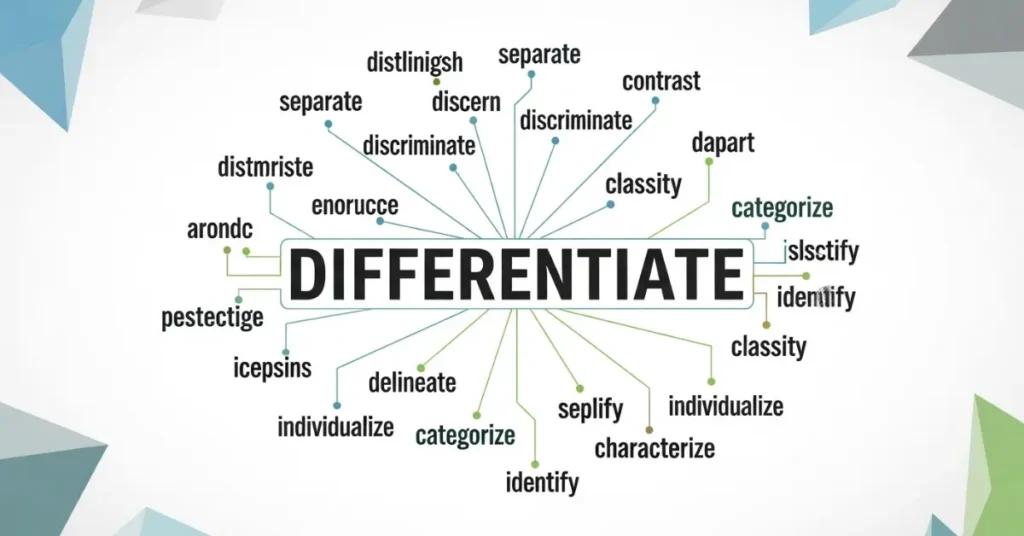
In class, Ali had two fruits, an apple and an orange. His teacher asked him to differentiate them. Ali said the apple is red and smooth, but the orange is round and rough.
The word differentiate means to show how things are not the same. It helps us compare ideas, objects, and people. Learning synonyms to differentiate is useful for students because it makes explanations clearer.
Below are 100 simple synonyms for differentiation with meanings and examples.
1. Distinguish
Meaning: To see or show the difference.
Examples:
- I can distinguish the twins by their hair.
- She can distinguish right from wrong.
2. Compare
Meaning: To look at things to see differences or similarities.
Examples:
- Compare the two pictures.
- He compared both answers.
3. Contrast
Meaning: To show clear differences.
Examples:
- Contrast the two ideas.
- She contrasted both colors.
4. Separate
Meaning: To keep things apart.
Examples:
- Separate the red and blue balls.
- He separated the papers.
5. Divide
Meaning: To split into parts.
Examples:
- Divide the items into groups.
- She divided the class.
6. Tell apart
Meaning: To recognize differences.
Examples:
- I can tell apart the birds.
- She can tell apart the sounds.
7. Classify
Meaning: To group by type.
Examples:
- Classify the animals.
- He classified the books.
8. Identify
Meaning: To recognize something.
Examples:
- Identify the correct answer.
- She identified the problem.
9. Mark out
Meaning: To show clearly.
Examples:
- Mark out the differences.
- He marked out the lines.
10. Set apart
Meaning: To be different from others.
Examples:
- This skill sets him apart.
- Her work is set apart.
11. Discriminate
Meaning: To see differences carefully.
Examples:
- He can discriminate between sounds.
- She learned to discriminate against colors.
12. Separate out
Meaning: To take apart from a group.
Examples:
- Separate out the good ones.
- He separated out the files.
13. Sort
Meaning: To arrange by type.
Examples:
- Sort the toys by size.
- She sorted the papers.
14. Categorize
Meaning: To put into groups.
Examples:
- Categorize the items.
- He categorized the data.
15. Label
Meaning: To name or tag.
Examples:
- Label each box.
- She labeled the parts.
16. Define
Meaning: To explain clearly.
Examples:
- Define the word.
- He defined the rule.
17. Recognize
Meaning: To know something.
Examples:
- I recognize his voice.
- She recognized the place.
18. Notice
Meaning: To see something clearly.
Examples:
- Notice the change.
- He noticed the difference.
19. Detect
Meaning: To discover differences.
Examples:
- Detect the error.
- She detected a problem.
20. Pick out
Meaning: To choose or see clearly.
Examples:
- Pick out the best one.
- He picked out the answer.
21. Tell the difference
Meaning: To know how things differ.
Examples:
- I can tell the difference.
- She can tell the difference easily.
22. Make distinct
Meaning: To show clearly different things.
Examples:
- Make the ideas distinct.
- He made the lines distinct.
23. Separate clearly
Meaning: To divide in a clear way.
Examples:
- Separate clearly the groups.
- She clearly separated the parts.
24. Draw a line between
Meaning: To show a difference.
Examples:
- Draw a line between truth and lies.
- He drew a line between ideas.
25. Show difference
Meaning: To display how things differ.
Examples:
- Show difference in answers.
- She showed a difference in colors.
26. Highlight
Meaning: To make something stand out.
Examples:
- Highlight the key points.
- He highlighted the difference.
27. Point out
Meaning: To show clearly.
Examples:
- Point out the mistake.
- She pointed out the change.
28. Explain difference
Meaning: To tell how things differ.
Examples:
- Explain the difference clearly.
- He explained the difference well.
29. Break apart
Meaning: To split into pieces.
Examples:
- Break apart the group.
- She broke apart the items.
30. Split
Meaning: To divide into parts.
Examples:
- Split the team.
- He split the work.
31. Separate by type
Meaning: To divide based on kind.
Examples:
- Separate by type.
- She separated by type.
32. Group
Meaning: To place together by type.
Examples:
- Group the items.
- He grouped the books.
33. Arrange
Meaning: To put in order.
Examples:
- Arrange the items.
- She arranged the files.
34. Compare closely
Meaning: To look carefully at differences.
Examples:
- Compare closely both sides.
- He compared closely.
35. Note difference
Meaning: To observe differences.
Examples:
- Note the difference.
- She noted the difference.
36. Tell clearly
Meaning: To show in a clear way.
Examples:
- Tell clearly the answer.
- He clearly told the difference.
37. Separate ideas
Meaning: To divide thoughts.
Examples:
- Separate ideas clearly.
- She separated ideas well.
38. Distinguish between
Meaning: To tell the difference between two things.
Examples:
- Distinguish between fact and opinion.
- He distinguished between ideas.
39. Draw contrast
Meaning: To show difference.
Examples:
- Draw contrast in colors.
- She drew contrast clearly.
40. Compare side by side
Meaning: To check differences together.
Examples:
- Compare side by side.
- He compared them side by side.
41. Separate lines
Meaning: To divide clearly.
Examples:
- Separate lines in work.
- She separated lines clearly.
42. Divide clearly
Meaning: To split in a clear way.
Examples:
- Divide the groups clearly.
- He was clearly divided.
43. Make clear
Meaning: To show clearly.
Examples:
- Make clear the difference.
- She made clear points.
44. Show contrast
Meaning: To show difference.
Examples:
- Show contrast in colors.
- He showed contrast.
45. Break into groups
Meaning: To divide into sets.
Examples:
- Break into groups.
- She broke into groups.
46. Set boundaries
Meaning: To show limits.
Examples:
- Set boundaries clearly.
- He set boundaries.
47. Separate parts
Meaning: To divide pieces.
Examples:
- Separate parts of the machine.
- She separated parts.
48. Make separate
Meaning: To divide into different parts.
Examples:
- Make separate lists.
- He made separate files.
49. Split apart
Meaning: To divide fully.
Examples:
- Split apart the items.
- She split apart the group.
50. Break down
Meaning: To divide into small parts.
Examples:
- Break down the problem.
- He broke down the steps.
51. Analyze
Meaning: To study parts carefully.
Examples:
- Analyze the data.
- She analyzed the results.
52. Examine
Meaning: To look closely.
Examples:
- Examine the details.
- He examined the answer.
53. Observe
Meaning: To watch carefully.
Examples:
- Observe the changes.
- She observed the pattern.
54. Study
Meaning: To learn carefully.
Examples:
- Study the differences.
- He studied the chart.
55. Check
Meaning: To look for accuracy.
Examples:
- Check the answers.
- She checked the list.
56. Review
Meaning: To look again.
Examples:
- Review the work.
- He reviewed the notes.
57. Compare details
Meaning: To check small differences.
Examples:
- Compare details carefully.
- She compared the details.
58. Spot difference
Meaning: To find difference.
Examples:
- Spot the difference.
- He spotted the change.
59. Notice change
Meaning: To see differences.
Examples:
- Notice the change.
- She noticed the shift.
60. Tell change
Meaning: To show change.
Examples:
- Tell change clearly.
- He told me to change easily.
61. Break into parts
Meaning: To divide into pieces.
Examples:
- Break into parts.
- She broke into parts.
62. Divide into groups
Meaning: To split into sets.
Examples:
- Divide into groups.
- He was divided into groups.
63. Sort out
Meaning: To organize clearly.
Examples:
- Sort out the items.
- She sorted out the files.
64. Lay apart
Meaning: To place separately.
Examples:
- Lay apart the books.
- He laid apart the tools.
65. Put apart
Meaning: To keep separate.
Examples:
- Put apart the items.
- She put apart the clothes.
66. Separate well
Meaning: To divide properly.
Examples:
- Separate the parts well.
- He separated well.
67. Make difference
Meaning: To create a difference.
Examples:
- Make the difference clear.
- She made the difference visible.
68. Tell apart clearly
Meaning: To see differences easily.
Examples:
- Tell apart clearly the shapes.
- He spoke clearly.
69. Mark difference
Meaning: To show difference.
Examples:
- Mark difference in answers.
- She marked the difference.
70. Point difference
Meaning: To show difference.
Examples:
- Point difference clearly.
- He pointed out the difference.
71. Identify difference
Meaning: To recognize differences.
Examples:
- Identify differences quickly.
- She identified the difference.
72. Note contrast
Meaning: To see difference.
Examples:
- Note contrast in colors.
- He noted contrast.
73. Show clearly
Meaning: To make it easy to see.
Examples:
- Show clearly the change.
- She showed it clearly.
74. Make distinct lines
Meaning: To separate clearly.
Examples:
- Make distinct lines.
- He made distinct lines.
75. Split clearly
Meaning: To divide clearly.
Examples:
- Split the parts clearly.
- She split clearly.
76. Break clearly
Meaning: To divide in a clear way.
Examples:
- Break clearly the groups.
- He broke clearly.
77. Separate evenly
Meaning: To divide equally.
Examples:
- Separate evenly the items.
- She separated evenly.
78. Compare deeply
Meaning: To check in detail.
Examples:
- Compare the ideas deeply.
- He compared deeply.
79. Study differences
Meaning: To learn differences.
Examples:
- Study differences carefully.
- She studied differences.
80. Observe difference
Meaning: To see difference.
Examples:
- Observe the difference closely.
- He observed a difference.
81. Examine difference
Meaning: To look at differences.
Examples:
- Examine differences well.
- She examined the difference.
82. Detect difference
Meaning: To find differences.
Examples:
- Detects differences quickly.
- He detected a difference.
83. Separate ideas clearly
Meaning: To divide thoughts clearly.
Examples:
- Separate ideas clearly.
- She separated ideas clearly.
84. Compare ideas
Meaning: To check ideas.
Examples:
- Compare ideas carefully.
- He compared ideas.
85. Contrast ideas
Meaning: To show idea differences.
Examples:
- Contrast ideas clearly.
- She contrasted ideas.
86. Show variation
Meaning: To display differences.
Examples:
- Show variation in results.
- He showed variation.
87. Mark variation
Meaning: To show change.
Examples:
- Mark variation clearly.
- She marked variation.
88. Identify variation
Meaning: To recognize change.
Examples:
- Identify variation quickly.
- He identified variation.
89. Note variation
Meaning: To observe change.
Examples:
- Note variation carefully.
- She noted variation.
90. Detect variation
Meaning: To find change.
Examples:
- Detects variation easily.
- He detected variation.
91. Separate clearly lines
Meaning: To divide lines clearly.
Examples:
- Separate clearly lines.
- She clearly separated lines.
92. Divide lines
Meaning: To split lines.
Examples:
- Divide lines properly.
- He divided lines.
93. Break lines
Meaning: To separate lines.
Examples:
- Break lines clearly.
- She broke lines.
94. Set apart clearly
Meaning: To show differences clearly.
Examples:
- Set apart ideas clearly.
- He set apart clearly.
95. Make difference clear
Meaning: To show differences clearly.
Examples:
- Make the difference clear.
- She made the difference clear.
96. Tell difference clearly
Meaning: To explain differences well.
Examples:
- Tell the difference clearly.
- He told the difference clearly.
97. Show difference clearly
Meaning: To display differences well.
Examples:
- Show differences clearly.
- She showed the difference clearly.
98. Compare clearly
Meaning: To check clearly.
Examples:
- Compare both items clearly.
- He compared clearly.
99. Contrast clearly
Meaning: To show a clear difference.
Examples:
- Contrast clear ideas.
- She contrasted clearly.
100. Distinguish clearly
Meaning: To see differences easily.
Examples:
- Distinguish clearly both objects.
- He distinguished clearly.
Conclusion
The word differentiate helps us show how things are not the same. Learning these synonyms to differentiate improves writing and understanding.

I am a passionate English content writer and vocabulary specialist dedicated to creating clear, engaging, and easy-to-understand articles. I focus on helping readers expand their vocabulary and improve their English skills through simple, informative, and practical content. My goal is to make learning English enjoyable, accessible, and meaningful for everyone.