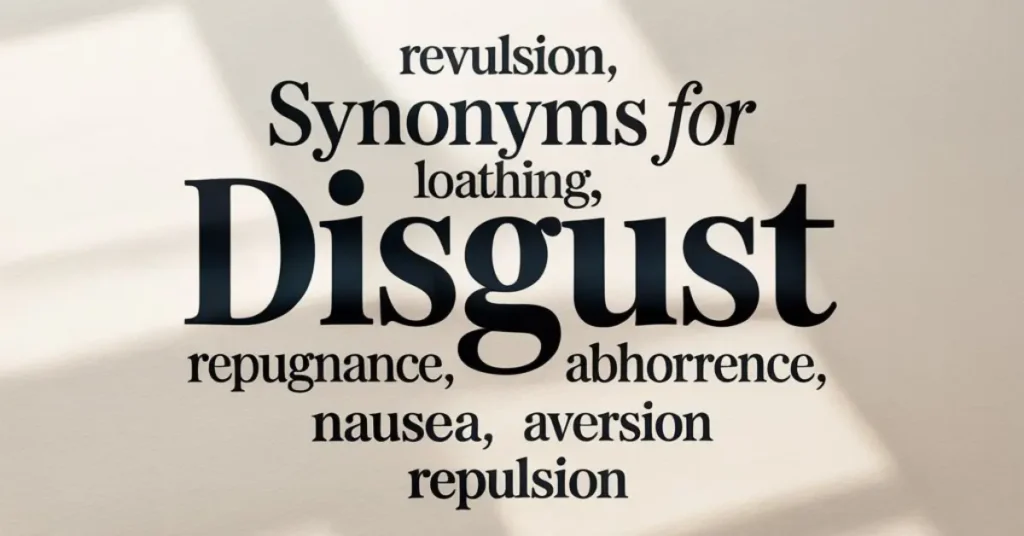
Disgust is a strong feeling of dislike or revulsion caused by something unpleasant, dirty or morally offensive.
A student opened a forgotten lunchbox after many days. A strong, bad smell came out, and he immediately stepped back and covered his nose.
That reaction was disgust.
Disgust is the feeling we get when something is very unpleasant to our senses or mind.
Synonyms List
1. Revulsion
Meaning: Strong feeling of disgust.
Examples: He felt revulsion at the smell. She reacted with revulsion.
2. Nausea
Meaning: Feeling of sickness caused by disgust.
Examples: The smell caused nausea. She fenauseoussea in the room.
3. Aversion
Meaning: Strong dislike for something unpleasant.
Examples: He has an aversion to dirty food. She showed an aversion to bad smells.
4. Repulsion
Meaning: Feeling pushed away by something unpleasant.
Examples: He felt repulsion at the sight. She reacted with repulsion.
5. Loathing
Meaning: Deep and strong disgust or hatred.
Examples: He felt loathing for the dirty place. She showed loathing.
6. Abhorrence
Meaning: Strong moral disgust.
Examples: He felt abhorrence toward cruelty. She expressed abhorrence.
7. Distaste
Meaning: Mild disgust or dislike.
Examples: He showed distaste for the food. She felt distaste.
8. Dislike
Meaning: Feeling of not liking something.
Examples: He has a dislike for onions. She showed dislike.
9. Hatred
Meaning: Very strong dislike.
Examples: He felt hatred for injustice. She expressed hatred.
10. Contempt
Meaning: Feeling something is worthless or disgusting.
Examples: He looked at it with contempt. She showed contempt.
11. Repugnance
Meaning: Strong disgust.
Examples: He felt repugnance at the act. She reacted with repugnance.
12. Offense
Meaning: Feeling of being disturbed or disgusted.
Examples: The smell gave offense. She felt offended.
13. Unease
Meaning: Slight discomfort or nervous disgust.
Examples: He felt unease in the room. She showed unease.
14. Displeasure
Meaning: Feeling of unhappiness or dislike.
Examples: He showed displeasure. She felt displeasure.
15. Sick feeling
Meaning: Feeling of sickness due to disgust.
Examples: He had a sick feeling. She felt a sick feeling.
16. Queasiness
Meaning: Slight nausea or discomfort.
Examples: He felt queasiness. She experienced queasiness.
17. Discomfort
Meaning: Feeling of uneasiness or discomfort.
Examples: He felt discomfort. She showed discomfort.
18. Revolt
Meaning: Strong inner rejection caused by disgust.
Examples: He felt revolt inside. She reacted with revolt.
19. Shock
Meaning: Sudden unpleasant emotional reaction.
Examples: He felt shock at the sight. She showed shock.
20. Horror
Meaning: Strong fear mixed with disgust.
Examples: He felt horror at the scene. She reacted with horror.
21. Distress
Meaning: Mental suffering caused by something unpleasant.
Examples: He felt distress. She showed distress.
22. Sickness
Meaning: Physical feeling of being unwell due to disgust.
Examples: The smell caused sickness. She feels sick.
23. Gross feeling
Meaning: Strong feeling that something is disgusting.
Examples: He had a gross feeling. She felt gross.
24. Repulsiveness
Meaning: Quality of being extremely unpleasant.
Examples: The repulsiveness was obvious. She noticed repulsiveness.
25. Unpleasantness
Meaning: Quality of being not nice or disgusting.
Examples: He felt unpleasantness. She noticed unpleasantness.
26. Sickening feeling
Meaning: Feeling that causes nausea.
Examples: He had a sickening feeling. She felt a sickening feeling.
27. Moral disgust
Meaning: Disgust caused by wrong actions.
Examples: He felt moral disgust. She showed moral disgust.
28. Physical disgust
Meaning: Disgust caused by senses like smell or sight.
Examples: He felt physical disgust. She reacted with physical disgust.
29. Mental revulsion
Meaning: Strong rejection in the mind.
Examples: He felt mental revulsion. She showed mental revulsion.
30. Strong dislike
Meaning: A very high level of dislike.
Examples: He has a strong dislike for it. She showed a strong dislike.
31. Deep aversion
Meaning: Very strong dislike.
Examples: He felt deep aversion. She showed deep aversion.
32. Intense disgust
Meaning: A very strong feeling of disgust.
Examples: He felt intense disgust. She showed intense disgust.
33. Extreme repulsion
Meaning: Very strong repulsion.
Examples: He felt extreme repulsion. She reacted with extreme repulsion.
34. Strong revulsion
Meaning: Powerful disgust feeling.
Examples: He felt strong revulsion. She showed strong revulsion.
35. Deep loathing
Meaning: Very strong hatred or disgust.
Examples: He felt deep loathing. She showed deep loathing.
36. Strong contempt
Meaning: Strong feeling of disrespect and disgust.
Examples: He showed strong contempt. She felt strong contempt.
37. Bitter disgust
Meaning: Harsh and strong disgust.
Examples: He felt bitter disgust. She showed bitter disgust.
38. Strong offense
Meaning: Strong feeling of being offended or disgusted.
Examples: He felt strong offense. She showed strong offense.
39. Sick disgust
Meaning: Disgust that causes a feeling of sickness.
Examples: He felt sickened. She reacted with sick disgust.
40. Emotional revulsion
Meaning: Disgust felt emotionally.
Examples: He felt emotional revulsion. She showed emotional revulsion.
41. Physical revulsion
Meaning: Body reaction of disgust.
Examples: He felt physical revulsion. She reacted physically with revulsion.
42. Mental disgust
Meaning: Disgust felt in the mind.
Examples: He felt mental disgust. She showed mental disgust.
43. Emotional disgust
Meaning: Disgust felt emotionally.
Examples: He felt emotional disgust. She showed emotional disgust.
44. Deep repulsion
Meaning: A very strong feeling of repulsion.
Examples: He felt deep repulsion. She reacted with deep repulsion.
45. Strong nausea
Meaning: Powerful sick feeling.
Examples: The smell caused strong nausea. She felt strong nausea.
46. Intense aversion
Meaning: Very strong dislike.
Examples: He has an intense aversion to dirt. She showed intense aversion.
47. Powerful disgust
Meaning: Very strong disgust feeling.
Examples: He felt powerful disgust. She reacted with powerful disgust.
48. Strong distaste
Meaning: High level of dislike.
Examples: He showed strong distaste. She felt strong distaste.
49. Deep disgust
Meaning: Very strong disgust.
Examples: He felt deep disgust. She showed deep disgust.
50. Complete revulsion
Meaning: Full and total disgust reaction.
Examples: He felt complete revulsion. She reacted with complete revulsion.
51. Total disgust
Meaning: Entire feeling of disgust.
Examples: He felt total disgust. She showed total disgust.
52. Full repulsion
Meaning: Complete repulsion feeling.
Examples: He felt full repulsion. She reacted with full repulsion.
53. Extreme aversion
Meaning: Very high dislike.
Examples: He has an extreme aversion to smell. She showed extreme aversion.
54. Strong rejection
Meaning: Rejecting something unpleasant.
Examples: He showed strong rejection. She felt strong rejection.
55. Deep rejection
Meaning: Strong rejection feeling.
Examples: He felt deep rejection. She showed deep rejection.
56. Emotional rejection
Meaning: Feeling-based rejection.
Examples: He felt emotional rejection. She showed emotional rejection.
57. Physical rejection
Meaning: Body reaction of rejection.
Examples: He felt physical rejection. She showed physical rejection.
58. Mental rejection
Meaning: Mind rejecting something.
Examples: He felt mental rejection. She showed mental rejection.
59. Sick rejection
Meaning: Disgust causes a feeling of sickness.
Examples: He felt sick rejection. She showed sick rejection.
60. Strong sickness feeling
Meaning: Intense nausea feeling.
Examples: He had a strong sense of feeling. She felt a strong sense of sickness.
61. Deep sickness
Meaning: Strong, sick feeling.
Examples: He felt deep sickness. She showed deep sickness.
62. Nauseous feeling
Meaning: Feeling of nausea.
Examples: He had nauseous feeling. She felt nauseous.
63. Sickened feeling
Meaning: Feeling made sick.
Examples: He felt sickened. She showed a sickened feeling.
64. Stomach-turning feeling
Meaning: Nausea sensation.
Examples: He had a stomach-turning feeling. She felt a stomach-turning feeling.
65. Gut disgust
Meaning: Deep inner disgust.
Examples: He felt gut disgust. She showed gut disgust.
66. Body revulsion
Meaning: Physical disgust reaction.
Examples: He felt body revulsion. She showed body revulsion.
67. Sensory disgust
Meaning: Disgust from senses.
Examples: He felt sensory disgust. She showed sensory disgust.
68. Visual disgust
Meaning: Disgust from sight.
Examples: He felt visual disgust. She showed visual disgust.
69. Smell disgust
Meaning: Disgust from smell.
Examples: He felt disgust. She showed smell disgust.
70. Taste disgust
Meaning: Disgust from taste.
Examples: He felt taste disgust. She showed taste disgust.
71. Touch disgust
Meaning: Disgust from touch.
Examples: He felt touch disgust. She showed total disgust.
72. Emotional repulsion
Meaning: Emotional rejection feeling.
Examples: He felt emotional repulsion. She showed emotional repulsion.
73. Mental repulsion
Meaning: Mind rejection feeling.
Examples: He felt mental repulsion. She showed mental repulsion.
74. Deep offense
Meaning: Strong offended feeling.
Examples: He felt deep offense. She showed deep offense.
75. Strong unpleasantness
Meaning: A very unpleasant feeling.
Examples: He felt strong unpleasantness. She showed strong unpleasantness.
76. Deep unpleasantness
Meaning: Strong, unpleasant feeling.
Examples: He felt deep unpleasantness. She showed deep unpleasantness.
77. Total aversion
Meaning: Complete dislike.
Examples: He has a total aversion. She showed total aversion.
78. Full aversion
Meaning: Entire dislike.
Examples: He felt full aversion. She showed full aversion.
79. Strong emotional disgust
Meaning: Emotional strong disgust.
Examples: He felt strong emotional disgust. She showed strong emotional disgust.
80. Deep emotional disgust
Meaning: Strong emotional rejection.
Examples: He felt deep emotional disgust. She showed deep emotional disgust.
81. Physical aversion
Meaning: Body-based dislike.
Examples: He felt physical aversion. She showed physical aversion.
82. Mental aversion
Meaning: Mind-based dislike.
Examples: He felt mental aversion. She showed mental aversion.
83. Emotional aversion
Meaning: Feeling-based dislike.
Examples: He felt emotional aversion. She showed emotional aversion.
84. Strong moral disgust
Meaning: Ethical disgust.
Examples: He felt strong moral disgust. She showed strong moral disgust.
85. Deep moral disgust
Meaning: Strong ethical disgust.
Examples: He felt deep moral disgust. She showed deep moral disgust.
86. Ethical repulsion
Meaning: Moral rejection feeling.
Examples: He felt ethical repulsion. She showed ethical repulsion.
87. Social disgust
Meaning: Disgust in social behavior.
Examples: He felt social disgust. She showed social disgust.
88. Behavioral disgust
Meaning: Reaction to behavior.
Examples: He felt behavioral disgust. She showed behavioral disgust.
89. Situational disgust
Meaning: Disgust in a situation.
Examples: He felt situational disgust. She showed situational disgust.
90. Instant disgust
Meaning: Immediate reaction.
Examples: He felt instant disgust. She showed instant disgust.
91. Sudden disgust
Meaning: Quick disgust feeling.
Examples: He felt sudden disgust. She showed sudden disgust.
92. Sharp disgust
Meaning: Strong sudden disgust.
Examples: He felt sharp disgust. She showed sharp disgust.
93. Immediate revulsion
Meaning: Instant strong disgust.
Examples: He felt immediate revulsion. She showed immediate revulsion.
94. Quick repulsion
Meaning: Fast reaction of disgust.
Examples: He felt quick repulsion. She showed quick repulsion.
95. Deep emotional revulsion
Meaning: Strong emotional disgust.
Examples: He felt deep emotional revulsion. She showed deep emotional revulsion.
96. Full emotional disgust
Meaning: Complete emotional disgust.
Examples: He felt full emotional disgust. She showed full emotional disgust.
97. Total revulsion feeling
Meaning: Entire disgust reaction.
Examples: He felt total revulsion. She showed total revulsion.
98. Maximum disgust
Meaning: Highest level of disgust.
Examples: He felt maximum disgust. She showed maximum disgust.
99. Ultimate revulsion
Meaning: Final strong disgust.
Examples: He felt ultimate revulsion. She showed ultimate revulsion.
100. Complete disgust
Meaning: Full and total disgust.
Examples: He felt complete disgust. She showed complete disgust.
Conclusion
Disgust is a strong reaction of dislike or rejection caused by something unpleasant. These synonyms explain different levels and forms of disgust.

I am a passionate English content writer and vocabulary specialist dedicated to creating clear, engaging, and easy-to-understand articles. I focus on helping readers expand their vocabulary and improve their English skills through simple, informative, and practical content. My goal is to make learning English enjoyable, accessible, and meaningful for everyone.