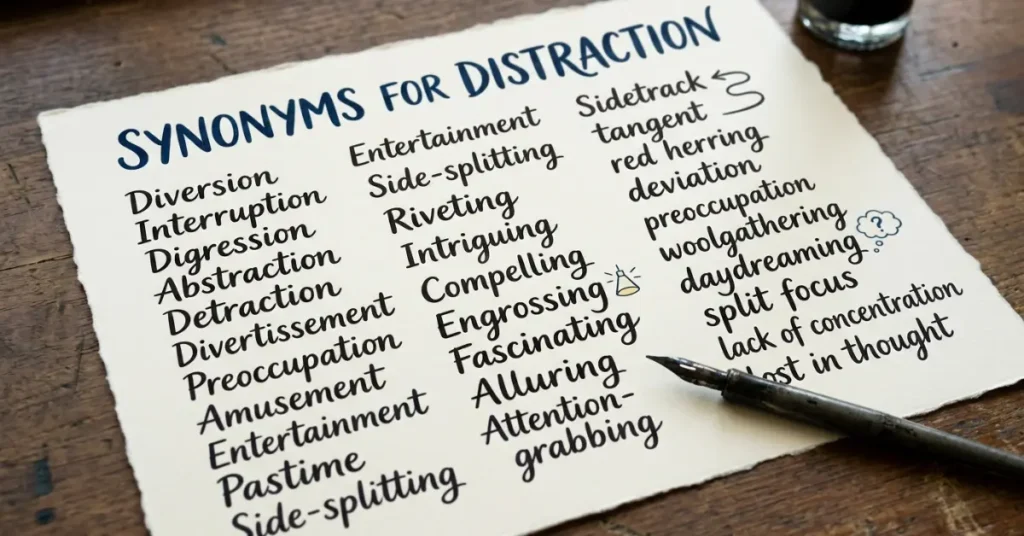
Distraction means something that takes your attention away from what you should focus on.
One day, Ali tried to study, but loud noise from outside pulled his attention away. His teacher said, “That noise is a distraction.” He learned that distraction means anything that breaks your focus or attention.
This word describes a thing or situation that stops you from concentrating on your work or task.
Learning similar words helps students explain focus and attention more clearly.
Below are 100 simple synonyms with meanings and examples.
1. Interruption
Meaning: Something that stops your activity.
Examples: The call caused an interruption.
Noise brings interruption during study.
2. Disturbance
Meaning: Something that breaks peace.
Examples: The loud music caused disturbance.
People dislike disturbance while working.
3. Disruption
Meaning: Something that breaks flow.
Examples: The noise caused disruption.
The class faced disruption.
4. Diversion
Meaning: Something that turns attention away.
Examples: The game became a diversion.
He used music as a diversion.
5. Sidetrack
Meaning: Something that moves you off track.
Examples: The phone call was a sidetrack.
Games can become a sidetrack.
6. Attention breaker
Meaning: Something that breaks focus.
Examples: Noise acts as an attention breaker.
Chat becomes an attention breaker.
7. Focus breaker
Meaning: Something that stops concentration.
Examples: The TV is a focus breaker.
Talking acts as a focus breaker.
8. Mind drift
Meaning: When thoughts move away.
Examples: His mind drift caused delay.
She felt mind drift in class.
9. Loss of focus
Meaning: Not paying attention.
Examples: Noise caused loss of focus.
Games bring loss of focus.
10. Inattention
Meaning: Lack of attention.
Examples: His inattention caused mistakes.
She showed inattention.
11. Break in focus
Meaning: Pause in concentration.
Examples: The noise caused a break in focus.
Chat led to a break in focus.
12. Mental drift
Meaning: Thoughts moving away.
Examples: He faced mental drift.
She noticed mental drift.
13. Side issue
Meaning: Something not important.
Examples: The talk became a side issue.
Games became a side issue.
14. Attention shift
Meaning: Focus moving away.
Examples: The noise caused an attention shift.
Phone use caused an attention shift.
15. Noise
Meaning: Unwanted sound.
Examples: Noise distracted him.
Noise broke her focus.
16. Commotion
Meaning: Loud activity.
Examples: The commotion disturbed class.
People reacted to commotion.
17. Chaos
Meaning: Disorder and confusion.
Examples: Chaos distracted the team.
The room had chaos.
18. Confusion
Meaning: Lack of clear thinking.
Examples: Confusion caused delay.
She faced confusion.
19. Distress
Meaning: Mental trouble.
Examples: Distress distracted him.
She felt distressed.
20. Agitation
Meaning: Nervous movement.
Examples: Agitation broke his focus.
She showed agitation.
21. Restlessness
Meaning: Inability to stay calm.
Examples: Restlessness distracted him.
She showed restlessness.
22. Preoccupation
Meaning: Thinking about something else.
Examples: Preoccupation caused mistakes.
She had preoccupation.
23. Daydreaming
Meaning: Thinking about unreal things.
Examples: Daydreaming distracted him.
She enjoyed daydreaming.
24. Wandering mind
Meaning: Thoughts moving freely.
Examples: His wandering mind slowed work.
She noticed her wandering mind.
25. Mind wandering
Meaning: Losing focus in thought.
Examples: Mind wandering caused delay.
She stopped mind wandering.
26. Attention loss
Meaning: Losing focus.
Examples: Attention loss caused errors.
She faced attention loss.
27. Focus loss
Meaning: Losing concentration.
Examples: Focus loss slowed him.
She noticed focus loss.
28. Break in attention
Meaning: Short loss of focus.
Examples: The call caused a break in attention.
Noise led to break in attention.
29. Side thought
Meaning: Thought not related.
Examples: Side thoughts distracted him.
She ignored side thoughts.
30. Mental noise
Meaning: Thoughts that disturb focus.
Examples: Mental noise slowed him.
She controlled mental noise.
31. External noise
Meaning: Outside disturbance.
Examples: External noise distracted him.
She avoided external noise.
32. Internal distraction
Meaning: Distraction from thoughts.
Examples: Internal distraction slowed him.
She faced internal distraction.
33. External distraction
Meaning: Distraction from outside.
Examples: External distraction broke focus.
She avoided external distraction.
34. Lack of attention
Meaning: Not focusing.
Examples: Lack of attention caused errors.
She showed lack of attention.
35. Diverted attention
Meaning: Focus moved away.
Examples: Diverted attention slowed work.
She had diverted attention.
36. Split attention
Meaning: Focus on many things.
Examples: Split attention caused mistakes.
She avoided split attention.
37. Overthinking
Meaning: Thinking too much.
Examples: Overthinking distracted him.
She stopped overthinking.
38. Side activity
Meaning: Extra activity.
Examples: Games became a side activity.
Chat was a side activity.
39. Idle talk
Meaning: Unnecessary talking.
Examples: Idle talk distracted him.
She avoided idle talk.
40. Chatter
Meaning: Continuous talking.
Examples: Chatter disturbed class.
She ignored chatter.
41. Gossip
Meaning: Talking about others.
Examples: Gossip distracted him.
She avoided gossip.
42. Entertainment
Meaning: Fun activity.
Examples: TV acted as entertainment.
Games became entertainment.
43. Amusement
Meaning: Something fun.
Examples: Amusement distracted him.
She enjoyed the amusement.
44. Play
Meaning: Fun activity.
Examples: Play distracted him.
She enjoyed playing.
45. Game
Meaning: Activity for fun.
Examples: Games distracted him.
She avoided games.
46. Screen time
Meaning: Time on devices.
Examples: Screen time distracted him.
She reduced screen time.
47. Phone use
Meaning: Using mobile devices.
Examples: Phone use distracted him.
She limited phone use.
48. Social media
Meaning: Online platforms.
Examples: Social media distracted him.
She avoided social media.
49. Video watching
Meaning: Watching videos.
Examples: Video watching distracted him.
She reduced video watching.
50. Music noise
Meaning: Loud music.
Examples: Music noise distracted him.
She lowered the music noise.
51. Background noise
Meaning: Constant sound.
Examples: Background noise distracted him.
She avoided background noise.
52. Traffic noise
Meaning: Sound from vehicles.
Examples: Traffic noise disturbed him.
She avoided traffic noise.
53. Loud sound
Meaning: Strong noise.
Examples: Loud sound distracted him.
She disliked loud sounds.
54. Sudden noise
Meaning: Unexpected sound.
Examples: Sudden noise scared him.
She reacted to the sudden noise.
55. Movement
Meaning: Physical motion.
Examples: Movement distracted him.
She noticed movement.
56. Activity
Meaning: Action around.
Examples: Activity distracted him.
She avoided activity.
57. Busy environment
Meaning: Active place.
Examples: Busy environment distracted him.
She avoided a busy environment.
58. Crowded place
Meaning: Many people.
Examples: Crowded places distracted him.
She left the crowded place.
59. Visual noise
Meaning: Too many visuals.
Examples: Visual noise distracted him.
She reduced visual noise.
60. Flashing lights
Meaning: Bright changing lights.
Examples: Flashing lights distracted him.
She avoided flashing lights.
61. Bright screen
Meaning: Strong light from screen.
Examples: Bright screen distracted him.
She dimmed the screen.
62. Side job
Meaning: Extra task.
Examples: Side job distracted him.
She handled side jobs.
63. Extra task
Meaning: Additional work.
Examples: Extra tasks distracted him.
She managed an extra task.
64. Multitasking
Meaning: Doing many tasks.
Examples: Multitasking distracted him.
She avoided multitasking.
65. Overload
Meaning: Too much work.
Examples: Overload distracted him.
She reduced overload.
66. Pressure
Meaning: Mental stress.
Examples: Pressure distracted him.
She handled pressure.
67. Stress
Meaning: Mental strain.
Examples: Stress distracted him.
She reduced stress.
68. Worry
Meaning: Thinking about problems.
Examples: Worry distracted him.
She avoided worry.
69. Anxiety
Meaning: Nervous feeling.
Examples: Anxiety distracted him.
She managed anxiety.
70. Concern
Meaning: Thought about a problem.
Examples: Concern distracted him.
She handled concern.
71. Fear
Meaning: Feeling afraid.
Examples: Fear distracted him.
She faced fear.
72. Doubt
Meaning: Lack of confidence.
Examples: Doubt distracted him.
She removed doubt.
73. Hesitation
Meaning: Delay in action.
Examples: Hesitation distracted him.
She avoided hesitation.
74. Delay
Meaning: Slowing progress.
Examples: Delay distracted him.
She avoided delay.
75. Pause
Meaning: Short stop.
Examples: Pause distracted him.
She resumed after pause.
76. Break
Meaning: Stop in activity.
Examples: Break distracted him.
She returned after break.
77. Gap
Meaning: Empty time.
Examples: Gap distracted him.
She filled the gap.
78. Drift
Meaning: Slow movement away.
Examples: Drift distracted him.
She noticed a drift.
79. Shift
Meaning: Change in focus.
Examples: Shift distracted him.
She avoided the shift.
80. Change of focus
Meaning: Moving attention.
Examples: Change of focus slowed him.
She avoided a change of focus.
81. Misfocus
Meaning: Wrong focus.
Examples: Misfocus distracted him.
She corrected misfocus.
82. Misattention
Meaning: Wrong attention.
Examples: Misattention caused error.
She avoided misattention.
83. Neglect
Meaning: Ignoring task.
Examples: Neglect distracted him.
She avoided neglect.
84. Carelessness
Meaning: Lack of care.
Examples: Carelessness distracted him.
She avoided carelessness.
85. Lack of concentration
Meaning: No focus.
Examples: Lack of concentration slowed him.
She improved concentration.
86. Broken focus
Meaning: Interrupted attention.
Examples: Broken focus caused mistakes.
She fixed the broken focus.
87. Weak attention
Meaning: Poor focus.
Examples: Weak attention slowed him.
She improved attention.
88. Scattered thoughts
Meaning: Disorganized thinking.
Examples: Scattered thoughts distracted him.
She controlled scattered thoughts.
89. Busy mind
Meaning: Too many thoughts.
Examples: A busy mind distracted him.
She calmed her mind.
90. Overactive mind
Meaning: Too much thinking.
Examples: Overactive mind distracted him.
She relaxed her mind.
91. Side noise
Meaning: Extra sound.
Examples: Side noise distracted him.
She avoided side noise.
92. Random thought
Meaning: Unplanned idea.
Examples: Random thoughts distracted him.
She ignored random thoughts.
93. Temptation
Meaning: Strong urge.
Examples: Temptation distracted him.
She resisted temptation.
94. Urge
Meaning: Strong desire.
Examples: Urge distracted him.
She controlled the urge.
95. Craving
Meaning: Strong want.
Examples: Craving distracted him.
She ignored craving.
96. Attraction
Meaning: Pull toward something.
Examples: Attraction distracted him.
She avoided attraction.
97. Pull
Meaning: Force drawing attention.
Examples: The game had a pull.
She felt the pull.
98. Draw
Meaning: Something that attracts.
Examples: The show was a draw.
She ignored the draw.
99. Lure
Meaning: Something tempting.
Examples: The lure distracted him.
She avoided the lure.
100. Hook
Meaning: Something that grabs attention.
Examples: The video was a hook.
She avoided the hook.
Conclusion
This word helps describe anything that breaks focus or attention. These synonyms make it easier to explain distractions in study, work and daily life.

I am a passionate English content writer and vocabulary specialist dedicated to creating clear, engaging, and easy-to-understand articles. I focus on helping readers expand their vocabulary and improve their English skills through simple, informative, and practical content. My goal is to make learning English enjoyable, accessible, and meaningful for everyone.