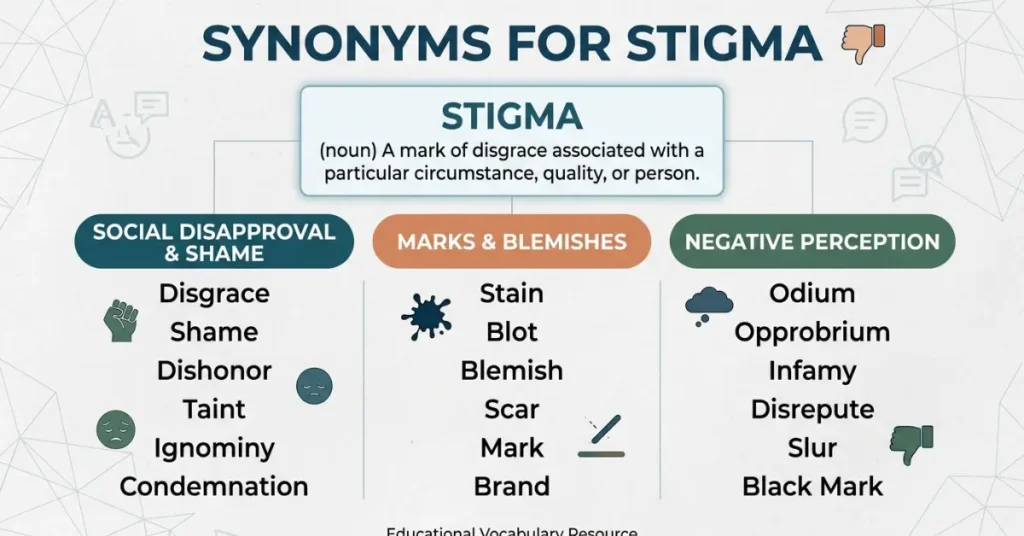
Stigma means a bad feeling or unfair opinion about a person or thing.
One day, a new boy joined Ali’s class. Some children avoided him because he came from another town. Ali’s teacher explained that this unfair treatment is called a stigma. The word means a negative mark, shame or unfair opinion that people place on someone or something.
Learning similar words helps improve speaking, reading and writing skills.
Below are 100 simple synonyms for “stigma” with meanings and examples.
1. Shame
Meaning: A painful feeling of embarrassment.
Examples: He felt shame after lying.
She carried shame for years.
2. Disgrace
Meaning: Loss of respect or honor.
Examples: The scandal brought disgrace.
He lived in disgrace afterward.
3. Embarrassment
Meaning: Feeling awkward or ashamed.
Examples: She faced embarrassment at school.
The mistake caused embarrassment.
4. Dishonor
Meaning: Loss of honor or respect.
Examples: The act brought dishonor.
He avoided dishonor in battle.
5. Humiliation
Meaning: Feeling deeply ashamed.
Examples: The harsh words caused humiliation.
He remembered the humiliation clearly.
6. Blame
Meaning: Responsibility for something wrong.
Examples: People placed blame on him.
She accepted the blame calmly.
7. Reproach
Meaning: Strong disappointment or criticism.
Examples: His actions brought reproach.
She spoke with reproach in her voice.
8. Scandal
Meaning: An event that shocks people badly.
Examples: The scandal spread quickly.
The news caused a scandal.
9. Mark
Meaning: A sign left behind.
Examples: The event left a mark.
The mistake made a lasting mark.
10. Stain
Meaning: A bad effect on reputation.
Examples: The lie left a stain.
The crime became a stain on history.
11. Bad name
Meaning: A poor reputation.
Examples: The company earned a bad name.
He feared getting a bad name.
12. Bad reputation
Meaning: Negative public opinion.
Examples: The shop gained a bad reputation.
He tried to fix his bad reputation.
13. Shamefulness
Meaning: The state of causing shame.
Examples: People noticed the shamefulness quickly.
The act showed shamefulness.
14. Fault
Meaning: A mistake or weakness.
Examples: They pointed out his fault.
She admitted her fault honestly.
15. Criticism
Meaning: Negative comments or judgment.
Examples: The idea faced criticism online.
He accepted criticism calmly.
16. Condemnation
Meaning: Strong public disapproval.
Examples: The decision received condemnation.
People showed condemnation openly.
17. Ridicule
Meaning: Unkind laughter or mocking.
Examples: The boy faced ridicule at school.
She ignored the ridicule bravely.
18. Mockery
Meaning: Making fun of someone.
Examples: The speech became mockery online.
He hated the mockery.
19. Disapproval
Meaning: A feeling that something is wrong.
Examples: The teacher showed disapproval.
Parents expressed disapproval loudly.
20. Rejection
Meaning: Refusing to accept someone or something.
Examples: The team faced rejection.
She handled rejection with courage.
21. Bias
Meaning: Unfair opinion about someone.
Examples: The rule showed bias.
People noticed the bias quickly.
22. Prejudice
Meaning: Unfair judgment before knowing facts.
Examples: The town struggled with prejudice.
She spoke against prejudice.
23. Stereotype
Meaning: A fixed unfair belief about people.
Examples: The movie repeated stereotypes.
He challenged the stereotype confidently.
24. Judgment
Meaning: Forming opinions about someone.
Examples: She feared judgment from others.
The speech invited judgment online.
25. Discredit
Meaning: Loss of trust or respect.
Examples: The lie caused discredit.
The mistake brought discredit.
26. Smear
Meaning: Harmful damage to reputation.
Examples: The rumor became a smear campaign.
The article created a smear.
27. Label
Meaning: A name unfairly placed on someone.
Examples: People gave him a hurtful label.
She strongly rejected the label.
28. Negative image
Meaning: A poor public picture.
Examples: The event created a negative image.
The company fought the negative image.
29. Shame mark
Meaning: A sign of shame.
Examples: The mistake felt like a shame mark.
He carried the shame mark silently.
30. Social shame
Meaning: Shame caused by society.
Examples: The family faced social shame.
People spoke about social shame openly.
31. Public shame
Meaning: Shame in front of many people.
Examples: The mistake caused public shame.
He feared public shame deeply.
32. Bad opinion
Meaning: Negative thoughts about someone.
Examples: The rumor created a bad opinion.
People formed a bad opinion quickly.
33. Negative view
Meaning: Unfavorable way of seeing something.
Examples: The article spread a negative view.
He changed the negative view slowly.
34. Disrespect
Meaning: Lack of respect.
Examples: The joke showed disrespect.
She disliked the disrespect.
35. Shameful mark
Meaning: A sign connected with shame.
Examples: The mistake became a shameful mark.
The scandal left a shameful mark.
36. Bad image
Meaning: Poor impression in public.
Examples: The event gave the brand a bad image.
He wanted to fix the bad image.
37. Exclusion
Meaning: Keeping someone out unfairly.
Examples: The child faced exclusion at school.
The rule caused exclusion.
38. Isolation
Meaning: Being separated from others.
Examples: The stigma caused isolation.
He struggled with isolation afterward.
39. Fear of judgment
Meaning: Worry about others’ opinions.
Examples: She carried fear of judgment.
Many people hide from fear of judgment.
40. Bad treatment
Meaning: Unfair or cruel behavior.
Examples: The workers faced bad treatment.
He spoke against bad treatment.
41. Unfair opinion
Meaning: Judgment without fairness.
Examples: The rumor created an unfair opinion.
People spread unfair opinions online.
42. Social pressure
Meaning: Pressure from society.
Examples: Teenagers often face social pressure.
The group struggled with social pressure.
43. Shameful reputation
Meaning: A reputation linked with shame.
Examples: The town gained a shameful reputation.
He wanted to escape the shameful reputation.
44. Negative label
Meaning: Harmful name given to someone.
Examples: The child received a negative label.
She ignored the negative label.
45. Public criticism
Meaning: Criticism from many people.
Examples: The actor faced public criticism.
The idea received public criticism.
46. Social rejection
Meaning: Rejection by society.
Examples: The family experienced social rejection.
He suffered social rejection.
47. Poor image
Meaning: Weak or negative reputation.
Examples: The mistake created a poor image.
The company fixed its poor image.
48. Bad impression
Meaning: Negative feeling about someone.
Examples: The lie left a bad impression.
He avoided making a bad impression.
49. Shameful memory
Meaning: A memory connected with shame.
Examples: He carried the shameful memory.
The event became a shameful memory.
50. Hurtful judgment
Meaning: Painful opinions from others.
Examples: The child feared hurtful judgment.
She ignored hurtful judgment bravely.
51. Social mark
Meaning: A mark placed by society.
Examples: The rumor became a social mark.
He struggled with the social mark.
52. Harmful belief
Meaning: A damaging idea about people.
Examples: The harmful belief spread quickly.
She fought the harmful belief.
53. Negative reaction
Meaning: Unfriendly response from people.
Examples: The speech received negative reaction.
He expected a negative reaction online.
54. Shameful label
Meaning: A label that causes shame.
Examples: The child carried a shameful label.
She strongly rejected the shameful label.
55. Harsh judgment
Meaning: Very critical opinion.
Examples: The actor faced harsh judgment.
She disliked harsh judgment online.
56. False belief
Meaning: Wrong idea about someone.
Examples: The false belief hurts many people.
He corrected the false belief.
57. Negative attention
Meaning: Unwanted public notice.
Examples: The scandal brought negative attention.
He avoided negative attention afterward.
58. Social blame
Meaning: Blame from society.
Examples: The group faced social blame unfairly.
She spoke against social blame.
59. Hurtful opinion
Meaning: Opinion that causes pain.
Examples: The comment carried hurtful opinion.
He ignored the hurtful opinion.
60. Shameful opinion
Meaning: Opinion linked with shame.
Examples: The rumor spread shameful opinion.
She challenged the shameful opinion.
61. Unfair label
Meaning: A wrong name placed on someone.
Examples: The student received an unfair label.
He rejected the unfair label.
62. Public disapproval
Meaning: Negative opinion from the public.
Examples: The decision faced public disapproval.
He feared public disapproval.
63. Social criticism
Meaning: Criticism from society.
Examples: The rule received social criticism.
She ignored social criticism calmly.
64. Shameful judgment
Meaning: Judgment connected with shame.
Examples: The rumor caused shameful judgment.
He avoided shameful judgment.
65. Damaged reputation
Meaning: Reputation harmed badly.
Examples: The lie caused damaged reputation.
She repaired her damaged reputation slowly.
66. Public embarrassment
Meaning: Embarrassment in front of people.
Examples: The mistake caused public embarrassment.
He remembered the public embarrassment.
67. Hurtful stereotype
Meaning: Harmful fixed belief about people.
Examples: The film repeated hurtful stereotypes.
She challenged hurtful stereotypes bravely.
68. Wrong judgment
Meaning: Incorrect opinion about someone.
Examples: The article spread wrong judgment.
People accepted the wrong judgment quickly.
69. Negative stereotype
Meaning: Harmful general belief.
Examples: The book discussed negative stereotypes.
He rejected the negative stereotype.
70. Bad social view
Meaning: Negative way society sees something.
Examples: The issue carried a bad social view.
She changed the bad social view slowly.
71. Public rejection
Meaning: Rejection from many people.
Examples: The idea faced public rejection.
He handled public rejection bravely.
72. Shameful treatment
Meaning: Treatment that causes shame.
Examples: The workers suffered shameful treatment.
She spoke against shameful treatment.
73. Social unfairness
Meaning: Unfair treatment in society.
Examples: The law created social unfairness.
He fought social unfairness.
74. Negative judgment
Meaning: Unfavorable opinion.
Examples: The speech received negative judgment.
She ignored negative judgment calmly.
75. Harsh opinion
Meaning: Strong negative opinion.
Examples: The article carried harsh opinion.
He disliked the harsh opinion.
76. Public blame
Meaning: Blame from many people.
Examples: The leader faced public blame.
She avoided public blame.
77. Social disgrace
Meaning: Disgrace caused by society.
Examples: The scandal created social disgrace.
He feared social disgrace deeply.
78. Negative reputation
Meaning: Poor reputation among people.
Examples: The company earned a negative reputation.
She improved the negative reputation.
79. Public mockery
Meaning: Being mocked openly.
Examples: The mistake caused public mockery.
He ignored the public mockery.
80. Social shame mark
Meaning: A shameful sign from society.
Examples: The rumor became a social shame mark.
She removed the social shame mark slowly.
81. Harmful label
Meaning: A label that hurts people.
Examples: The harmful label spreads quickly.
He rejected the harmful label.
82. Shameful idea
Meaning: An idea connected with shame.
Examples: The rumor created shameful ideas.
She challenged the shameful idea.
83. Public stain
Meaning: A public mark of shame.
Examples: The scandal became a public stain.
He removed the public stain slowly.
84. Social stain
Meaning: A shameful mark in society.
Examples: The event left a social stain.
She fought against the social stain.
85. Negative social mark
Meaning: Harmful social sign.
Examples: The rumor created a negative social mark.
He struggled with negative social marks.
86. Hurtful blame
Meaning: Painful criticism.
Examples: The child faced hurtful blame.
She ignored hurtful blame bravely.
87. Social judgment
Meaning: Judgment from society.
Examples: Teenagers often fear social judgment.
He challenged social judgment openly.
88. Shameful criticism
Meaning: Criticism that causes shame.
Examples: The article carried shameful criticism.
She ignored the shameful criticism.
89. Harmful judgment
Meaning: Judgment that hurts people.
Examples: The rumor spread harmful judgment.
He fought harmful judgment bravely.
90. Social disapproval
Meaning: Disapproval from society.
Examples: The idea received social disapproval.
She ignored social disapproval calmly.
91. Negative public view
Meaning: Bad public opinion.
Examples: The issue created a negative public view.
He improved the negative public view.
92. Public shame mark
Meaning: Public sign of shame.
Examples: The scandal became a public shame mark.
She erased the public shame mark slowly.
93. Bad social opinion
Meaning: Harmful opinion from society.
Examples: The rumor caused bad social opinion.
He challenged bad social opinion.
94. Hurtful social view
Meaning: Painful way society sees people.
Examples: The article spread hurtful social views.
She fought the hurtful social view.
95. Public disrespect
Meaning: Open lack of respect.
Examples: The speaker faced public disrespect.
He disliked public disrespect.
96. Social humiliation
Meaning: Humiliation caused by society.
Examples: The child suffered social humiliation.
She spoke against social humiliation.
97. Damaging stereotype
Meaning: Harmful fixed ideas about people.
Examples: The show repeated damaging stereotypes.
He challenged damaging stereotypes.
98. Social mocking
Meaning: Mocking by groups of people.
Examples: The child faced social mocking.
She ignored social mocking bravely.
99. Public dishonor
Meaning: Open loss of respect.
Examples: The lie caused public dishonor.
He feared public dishonor deeply.
100. Shameful social image
Meaning: Negative public image linked with shame.
Examples: The rumor created a shameful social image.
She worked hard to change the shameful social image.
Conclusion
The word stigma describes shame, unfair judgment and negative opinions about people or situations. Learning these synonyms helps improve vocabulary and makes speaking and writing easier.

I am a professional English article writer with expertise in creating clear, well-researched, and engaging content. I specialize in writing informative articles that maintain accuracy, strong structure, and a polished tone. My work reflects a deep understanding of grammar, vocabulary, and audience needs. I am committed to delivering high-quality content that communicates ideas effectively and adds value to readers.