
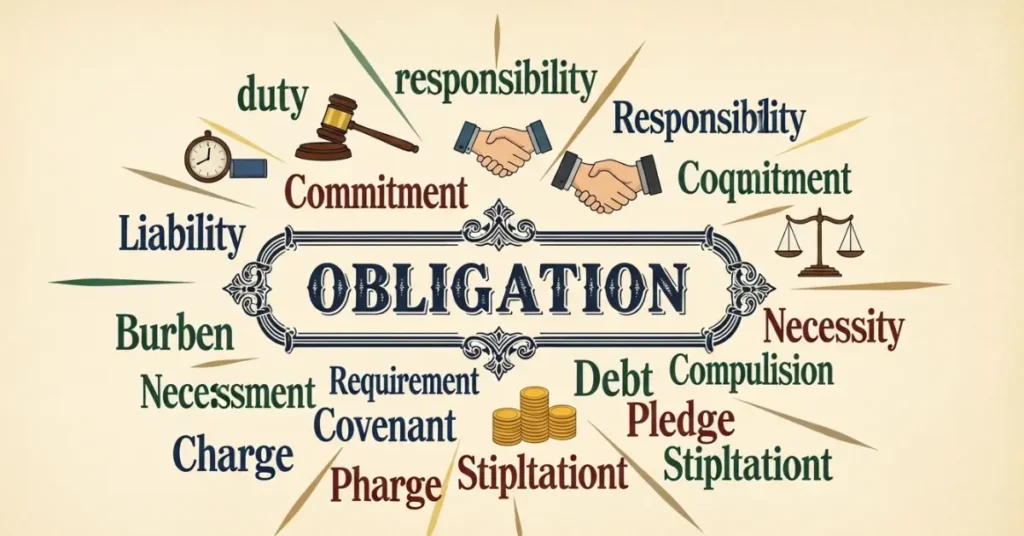
Sometimes we must do something because it is required. Maybe it’s helping at home, finishing homework, or following rules. When you have to do something, it is called an obligation.
An obligation is something you must do because it is right, legal, or expected. Learning synonyms of obligation helps speakers describe duties, responsibilities, and commitments clearly. These words are useful in stories, essays, blogs, and daily conversations.
Below are 50 easy synonyms of obligation written in simple English with meanings.
Synonyms List
1. Duty
Meaning: Something you must do.
Difference: Duty is a general word for responsibility or task.
Examples:
- It is my duty to help my parents.
- Cleaning the room is his duty.
2. Responsibility
Meaning: Being in charge or having to do something.
Difference: Responsibility emphasizes accountability for actions.
Examples:
- She has responsibility for the project.
- Parents have responsibility for their children.
3. Commitment
Meaning: A promise or pledge to do something.
Difference: Commitment emphasizes personal or moral promise.
Examples:
- He kept his commitment to study.
- She has a commitment to help the team.
4. Requirement
Meaning: Something needed or demanded.
Difference: Requirement emphasizes rules or standards.
Examples:
- Wearing a uniform is a school requirement.
- Completing the form is a requirement.
5. Charge
Meaning: A duty or task given to someone.
Difference: Charge emphasizes being given responsibility.
Examples:
- He is in charge of the event.
- She accepted the charge of teaching.
6. Burden
Meaning: A heavy responsibility.
Difference: Burden emphasizes weight or difficulty of duty.
Examples:
- Taking care of the sick was a burden.
- The decision was a heavy burden.
7. Task
Meaning: A piece of work you must do.
Difference: Task emphasizes specific activity or job.
Examples:
- Your task is to clean the desk.
- He finished the task quickly.
8. Job
Meaning: Work you have to do.
Difference: Job is informal and general for duties.
Examples:
- My job is to water the plants.
- This is a small job for you.
9. Function
Meaning: A role or duty you perform.
Difference: Function emphasizes position or role.
Examples:
- Her function is to organize meetings.
- The teacher’s function is to guide students.
10. Obligation
Meaning: Something you must do.
Difference: Obligation is formal, for moral, legal, or social duty.
Examples:
- Paying taxes is an obligation.
- It is his obligation to help.
11. Commitment of duty
Meaning: Promise to do a duty.
Difference: Emphasizes duty in a promised sense.
Examples:
- He has a commitment of duty to his team.
- Teachers have a commitment of duty to students.
12. Accountability
Meaning: Being responsible for actions.
Difference: Emphasizes answerability for performance.
Examples:
- He takes accountability for mistakes.
- She shows accountability in her work.
13. Pledge
Meaning: A promise to do something.
Difference: Pledge emphasizes vow or promise.
Examples:
- He made a pledge to help the poor.
- The student took a pledge to study hard.
14. Liability
Meaning: Legal responsibility.
Difference: Liability emphasizes legal or financial duty.
Examples:
- The company has liability for damages.
- He accepted liability for the accident.
15. Compulsion
Meaning: Being forced to do something.
Difference: Compulsion emphasizes pressure or necessity.
Examples:
- He acted under compulsion.
- Paying the fine was a compulsion.
16. Burden of duty
Meaning: Heavy responsibility.
Difference: Emphasizes difficulty of the obligation.
Examples:
- Caring for the house is a burden of duty.
- He accepted the burden of duty.
17. Contractual duty
Meaning: Duty by agreement or contract.
Difference: Legal or formal obligations.
Examples:
- Signing the paper is a contractual duty.
- They fulfilled their contractual duty.
18. Requirement by law
Meaning: Duty mandated by rules or law.
Difference: Legal obligation.
Examples:
- Voting is a requirement by law in some countries.
- Filing taxes is a requirement by law.
19. Moral duty
Meaning: Duty based on what is right.
Difference: Ethical or personal sense of responsibility.
Examples:
- Helping the poor is a moral duty.
- She felt a moral duty to speak.
20. Social duty
Meaning: Responsibility to society.
Difference: Duty for the common good.
Examples:
- Recycling is a social duty.
- Voting is a social duty.
21. Ethical responsibility
Meaning: Duty based on ethics.
Difference: Focus on moral correctness.
Examples:
- Doctors have ethical responsibility to patients.
- Honesty is an ethical responsibility.
22. Commitment to action
Meaning: Promise to do something.
Difference: Emphasizes promise with action.
Examples:
- He has a commitment to action for charity.
- She showed commitment to action in the project.
23. Duty-bound
Meaning: Required by duty.
Difference: Emphasizes personal sense of responsibility.
Examples:
- He was duty-bound to report the problem.
- The soldiers were duty-bound to follow orders.
24. Civic duty
Meaning: Responsibility of a citizen.
Difference: Emphasizes duties in community or nation.
Examples:
- Voting is a civic duty.
- Paying taxes is a civic duty.
25. Personal responsibility
Meaning: Duty to oneself or others.
Difference: Emphasizes individual accountability.
Examples:
- Exercise is part of personal responsibility.
- Completing homework is a personal responsibility.
26. Duty of care
Meaning: Responsibility to protect others.
Difference: Emphasizes safety or protection.
Examples:
- Parents have a duty of care for children.
- The company has a duty of care to employees.
27. Requirement of role
Meaning: What the position demands.
Difference: Emphasizes job-specific duty.
Examples:
- Listening is a requirement of the role.
- Management requires responsibility as a requirement of the role.
28. Compulsory task
Meaning: Task you must do.
Difference: Emphasizes mandatory duty.
Examples:
- Attending the meeting was a compulsory task.
- Homework is a compulsory task.
29. Imperative
Meaning: Necessary or very important duty.
Difference: Emphasizes urgent or essential action.
Examples:
- It is imperative to follow rules.
- Safety checks are imperative.
30. Essential duty
Meaning: Very important duty.
Difference: Focus on importance rather than amount.
Examples:
- Feeding the children is an essential duty.
- Cleaning the kitchen is an essential duty.
31. Responsibility of office
Meaning: Duty related to a position.
Difference: Formal and job-related duty.
Examples:
- Signing papers is the responsibility of the office.
- Managing staff is the responsibility of the office.
32. Binding duty
Meaning: Must be done; legally or morally.
Difference: Emphasizes obligation that cannot be ignored.
Examples:
- He accepted the binding duty.
- The contract gave a binding duty.
33. Requirement of law
Meaning: Legal duty.
Difference: Formal and mandatory.
Examples:
- Filing taxes is a requirement of law.
- Wearing a helmet is a requirement of law.
34. Mandatory task
Meaning: Must be done.
Difference: Emphasizes rules or authority.
Examples:
- Submitting forms is a mandatory task.
- Training is a mandatory task.
35. Expected duty
Meaning: Duty people expect you to do.
Difference: Emphasizes social expectation.
Examples:
- Parents have an expected duty to care for children.
- Teachers have an expected duty to teach.
36. Charge of duty
Meaning: Being responsible.
Difference: Emphasizes assignment of task.
Examples:
- He took charge of duty for the project.
- She accepted the charge of duty.
37. Required action
Meaning: Something you must do.
Difference: Emphasizes necessary acts.
Examples:
- Paying the fee is a required action.
- Completing the form requires action.
38. Moral obligation
Meaning: Duty based on ethics.
Difference: Focuses on right or wrong.
Examples:
- Donating to charity is a moral obligation.
- Helping neighbors is a moral obligation.
39. Civic responsibility
Meaning: Duty as a citizen.
Difference: Focuses on society and community.
Examples:
- Voting is a civic responsibility.
- Keeping streets clean is civic responsibility.
40. Accountability duty
Meaning: Duty for which you are responsible.
Difference: Emphasizes being answerable.
Examples:
- He had an accountability duty to his manager.
- Teachers have an accountability duty for students.
41. Job obligation
Meaning: Duty connected to work.
Difference: Emphasizes professional or official role.
Examples:
- Filing reports is a job obligation.
- Attending meetings is a job obligation.
42. Formal duty
Meaning: Duty required by rules or law.
Difference: Emphasizes official requirement.
Examples:
- Filing taxes is formal duty.
- Jury duty is formal duty.
43. Legal duty
Meaning: Duty required by law.
Difference: Legal obligation.
Examples:
- Driving safely is a legal duty.
- Paying rent is a legal duty.
44. Duty to act
Meaning: Must take action.
Difference: Focus on the necessity of acting.
Examples:
- Police have a duty to act in emergencies.
- Teachers have a duty to act for students.
45. Compulsory duty
Meaning: Must do it; mandatory.
Difference: Emphasizes requirement.
Examples:
- Completing homework is a compulsory duty.
- Voting is a compulsory duty.
46. Ethical duty
Meaning: Duty based on right and wrong.
Difference: Focuses on morals.
Examples:
- Doctors have an ethical duty to patients.
- Helping the poor is an ethical duty.
47. Required responsibility
Meaning: Must be done.
Difference: Emphasizes necessity and responsibility.
Examples:
- Submitting a report is a required responsibility.
- Cleaning the classroom is a required responsibility.
48. Commitment of obligation
Meaning: Promise to fulfill duty.
Difference: Emphasizes promise along with responsibility.
Examples:
- He has a commitment of obligation to charity.
- Teachers have a commitment of obligation to students.
49. Essential responsibility
Meaning: Very important duty.
Difference: Highlights necessity.
Examples:
- Caring for children is an essential responsibility.
- Paying bills is an essential responsibility.
50. Required duty
Meaning: Duty you must do.
Difference: Simple, formal, and general.
Examples:
- Filing taxes is a required duty.
- Following instructions is a required duty.
Conclusion
Learning synonyms of obligation helps you describe duties, responsibilities, and commitments clearly. Using these words makes writing, speaking, and storytelling stronger and easier to understand.

I am a professional English article writer with expertise in creating clear, well-researched, and engaging content. I specialize in writing informative articles that maintain accuracy, strong structure, and a polished tone. My work reflects a deep understanding of grammar, vocabulary, and audience needs. I am committed to delivering high-quality content that communicates ideas effectively and adds value to readers.