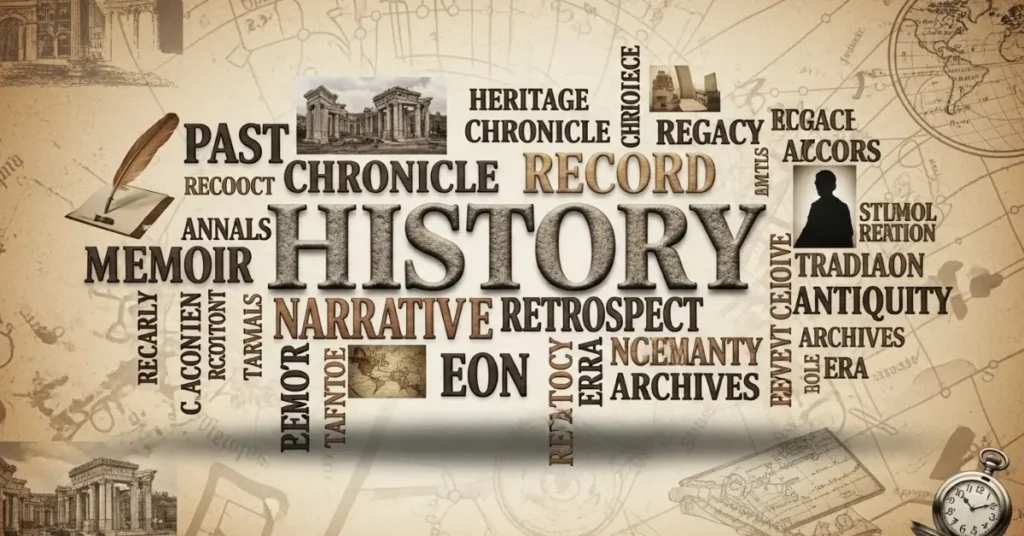
History helps us understand the past. It tells stories of people, events, and discoveries. Sometimes, we want to use other words instead of history to make writing more interesting.
History is the record of past events. These words are useful in essays, blogs, stories, and daily conversations.
Below are 50 easy synonyms of history written in simple English.
Synonyms List
1. Past
Meaning: Things that happened before now.
Difference: Simple and general.
Examples:
- We learn from the past to make better choices.
- The past can teach us many lessons.
2. Record
Meaning: Written or remembered events.
Difference: Focus on documented events.
Examples:
- The record shows the town’s old events.
- Keep a record of what happens every day.
3. Chronicle
Meaning: Detailed story of past events.
Difference: Often formal, written form.
Examples:
- The book is a chronicle of the king’s life.
- She wrote a chronicle of her village.
4. Story
Meaning: Something told about the past.
Difference: Simple, friendly.
Examples:
- My grandmother tells stories of her youth.
- That story explains how the city began.
5. Tale
Meaning: Story from the past.
Difference: Often imaginative or entertaining.
Examples:
- The tale of the old warrior is inspiring.
- He told a tale of his adventures.
6. Annals
Meaning: Historical records year by year.
Difference: Formal, used in history books.
Examples:
- The annals of the town are in the library.
- Scholars study the annals for past events.
7. Heritage
Meaning: Things passed down from the past.
Difference: Focuses on culture and tradition.
Examples:
- Our heritage teaches us about our roots.
- She learned about her family heritage.
8. Background
Meaning: Past events that shape something.
Difference: Often personal or context-related.
Examples:
- His background helped him become strong.
- We studied the background of the conflict.
9. Biography
Meaning: Story of a person’s life.
Difference: Focus on one person.
Examples:
- I read a biography of Albert Einstein.
- Her biography is inspiring for students.
10. Memoir
Meaning: Personal record of past experiences.
Difference: Focus on personal events.
Examples:
- She wrote a memoir of her childhood.
- The memoir tells true events from her life.
11. Retrospect
Meaning: Thinking about the past.
Difference: Focus on reflecting.
Examples:
- In retrospect, it was a good decision.
- Looking back in retrospect, we learned much.
12. Recollection
Meaning: Memory of past events.
Difference: Personal memory.
Examples:
- His recollection of school days is funny.
- She shared her recollection of the festival.
13. Saga
Meaning: Long story of events.
Difference: Often adventurous or dramatic.
Examples:
- The saga of the warriors is famous.
- That saga is told for generations.
14. Legend
Meaning: Story from the past, often famous.
Difference: May include myths or exaggeration.
Examples:
- The legend of King Arthur is well known.
- That legend is told every year.
15. Myth
Meaning: Traditional story, not always true.
Difference: Focus on imagination or beliefs.
Examples:
- The myth of the phoenix is old.
- People tell myths about heroes.
16. Antiquity
Meaning: Very old time or ancient events.
Difference: Focuses on long ago.
Examples:
- Artifacts from antiquity are in the museum.
- We study civilizations of antiquity.
17. Tradition
Meaning: Custom passed from the past.
Difference: Focus on cultural practices.
Examples:
- It’s a tradition to celebrate festivals.
- Family traditions keep memories alive.
18. Legacy
Meaning: Things left from the past.
Difference: Often positive influence or gift.
Examples:
- His legacy lives on in his work.
- The legacy of the old king is famous.
19. Documentation
Meaning: Written record of past events.
Difference: Formal, official.
Examples:
- Documentation of the war is in archives.
- They kept documentation of every step.
20. Storyline
Meaning: Sequence of events.
Difference: Can be historical or fictional.
Examples:
- The storyline of the revolution is clear.
- The movie follows a historical storyline.
21. Report
Meaning: Written or spoken account.
Difference: Factual, formal.
Examples:
- The report explains the city’s past.
- He submitted a report about the school.
22. Chronicle account
Meaning: Detailed account of events.
Difference: Emphasizes order and detail.
Examples:
- The chronicle account shows the festival.
- Scholars studied the chronicle account carefully.
23. History book
Meaning: Book about past events.
Difference: Literal, educational.
Examples:
- I borrowed a history book from the library.
- The history book tells ancient stories.
24. Journal
Meaning: Record of events in writing.
Difference: Personal or formal.
Examples:
- He kept a journal of his travels.
- The journal recorded daily events.
25. Account
Meaning: Description of past events.
Difference: General and simple.
Examples:
- His account of the journey is inspiring.
- She gave an account of her childhood.
26. Documentation record
Meaning: Official record of past events.
Difference: Formal and precise.
Examples:
- The documentation record was complete.
- Historians check the documentation record.
27. Evidence
Meaning: Proof of past events.
Difference: Emphasizes proof.
Examples:
- The evidence shows what happened.
- Ancient ruins are evidence of history.
28. Archive
Meaning: Place where old records are kept.
Difference: Physical or digital.
Examples:
- The archives hold letters from the past.
- We visited the archive to study history.
29. Oral history
Meaning: Past events told by word of mouth.
Difference: Spoken stories.
Examples:
- Grandparents share oral history.
- Oral history preserves culture.
30. Historical account
Meaning: Record of past events.
Difference: Formal description.
Examples:
- The historical account is well-written.
- We read a historical account of the war.
31. Old times
Meaning: Long ago.
Difference: Simple and casual.
Examples:
- People talk about the old times.
- In old times, life was different.
32. Antiquarian record
Meaning: Record from ancient times.
Difference: Formal, academic.
Examples:
- The antiquarian record shows early settlements.
- Scholars study antiquarian records.
33. Past events
Meaning: Things that happened before.
Difference: Direct and simple.
Examples:
- Past events teach lessons.
- We remember past events carefully.
34. Remembrance
Meaning: Act of remembering the past.
Difference: Focus on memory.
Examples:
- Remembrance of heroes inspires us.
- We held a day of remembrance.
35. Recount
Meaning: Tell past events.
Difference: Simple, narrative.
Examples:
- She recounted her school days.
- He recounted the story of the village.
36. Reminiscence
Meaning: Memory or story from the past.
Difference: Personal and nostalgic.
Examples:
- He shared reminiscences of his childhood.
- Her reminiscence made everyone smile.
37. Story of events
Meaning: Description of past things.
Difference: General and friendly.
Examples:
- The story of events was exciting.
- She told the story of events in her town.
38. Memory
Meaning: Something remembered from the past.
Difference: Personal or collective.
Examples:
- I have memories of my first school day.
- The museum preserves memories of the war.
39. Annal
Meaning: Yearly record of events.
Difference: Formal, historical.
Examples:
- The annal shows the king’s deeds.
- Scholars study the annal carefully.
40. Account of past
Meaning: Description of past events.
Difference: General, formal or casual.
Examples:
- The account of the past helps students learn.
- He wrote an account of past events.
41. Historical record
Meaning: Written record of past.
Difference: Formal, factual.
Examples:
- The historical record is in the library.
- They studied the historical record.
42. Memory lane
Meaning: Thinking about past memories.
Difference: Informal, nostalgic.
Examples:
- Walking through old streets is a memory lane.
- They walked down memory lane together.
43. Retelling
Meaning: Telling the past again.
Difference: Narrative, can be casual.
Examples:
- The retelling of events was funny.
- She enjoyed retelling old stories.
44. Storytelling
Meaning: Act of telling past events.
Difference: Focuses on telling, not recording.
Examples:
- Storytelling helps preserve history.
- He is good at storytelling.
45. Chronicle of events
Meaning: Detailed past account.
Difference: Formal, detailed.
Examples:
- The chronicle of events shows the war.
- Scholars read the chronicle of events.
46. Historical narrative
Meaning: Story of history.
Difference: Formal, written.
Examples:
- The historical narrative is very clear.
- Students read a historical narrative in class.
47. Lineage
Meaning: History of family or ancestors.
Difference: Focuses on ancestry.
Examples:
- The family lineage is important.
- She studied her lineage carefully.
48. Genealogy
Meaning: Study of family history.
Difference: Specific, family-focused.
Examples:
- Genealogy shows our ancestors.
- He researched genealogy for years.
49. Record of deeds
Meaning: Past actions or achievements.
Difference: Emphasizes actions.
Examples:
- The record of deeds shows bravery.
- Students studied the record of deeds.
50. Past account
Meaning: Description of events from before.
Difference: General, simple.
Examples:
- The past account is interesting.
- He wrote a past account of his school life.
Conclusion
Learning synonyms of history helps describe the past in different ways. These words make stories, essays, and blogs richer. Practicing these words improves writing and daily conversations.

I am a professional English article writer with expertise in creating clear, well-researched, and engaging content. I specialize in writing informative articles that maintain accuracy, strong structure, and a polished tone. My work reflects a deep understanding of grammar, vocabulary, and audience needs. I am committed to delivering high-quality content that communicates ideas effectively and adds value to readers.